Your Competitors Are Using AI Chatbots to Serve Customers 24/7. Are You Still Relying on a Human Team Alone?
In 2026, AI chatbots are no longer a "big company" technology. They are affordable, easy to deploy, and delivering measurable ROI for businesses of every size — from local retailers to global enterprises. Here is everything a business owner needs to know.
AI AUTOMATION
Jyotsna
5/4/20265 min read
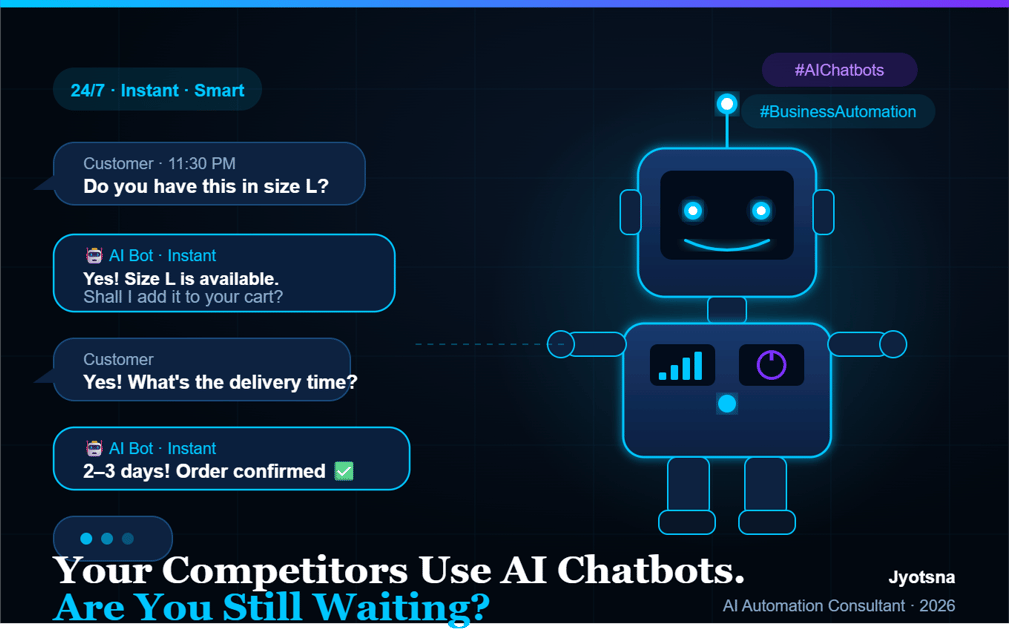
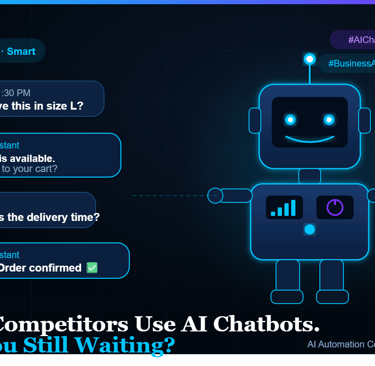
Let me start with a scenario most business owners know too well. It's 11:30 PM. A potential customer lands on your website, has a question about your product, and cannot find an answer. They leave. They go to your competitor, who has a chatbot live on their site — and by midnight, that competitor has a new customer that should have been yours.
This is not a hypothetical. It is the reality of running a business in 2026, where customer expectations have permanently shifted. People want instant answers — not the next morning, not after a hold queue. Right now.
The good news? AI chatbot technology has matured to the point where any business — regardless of size or technical expertise — can deploy a sophisticated, intelligent chatbot in a matter of days. And the numbers behind this technology are impossible to ignore.
$11B
Annual savings possible through AI chatbot automation. Juniper Research estimates businesses can save up to $11 billion per year and 2.5 billion working hours through chatbot deployment.
What Exactly Is an AI Chatbot — and Why Is 2026 Different?
An AI chatbot is a software program that uses artificial intelligence to have real, natural conversations with your customers — on your website, WhatsApp, Instagram, or any messaging platform. It understands what the customer is asking, responds intelligently, and can complete tasks: booking appointments, processing orders, qualifying leads, resolving complaints.
But here is what makes 2026 fundamentally different from even two or three years ago. The old generation of chatbots were essentially glorified FAQ menus — rigid, frustrating, and easy to confuse. Today's AI chatbots are powered by large language models (the same technology behind ChatGPT) and can handle multi-step conversations, understand context, connect to your CRM and inventory systems, and seamlessly hand off to a human agent when needed — along with the full chat history.
"82% of customers say they would rather talk to a chatbot than wait on hold for a human agent." — Tidio Research, 2026
That figure tells you everything about where customer preference has moved. The barrier to chatbot adoption is no longer the technology — it is awareness and action.
$0.50
Average cost of an AI chatbot interaction — compared to $6–$15 for a human agent interaction. The economics are clear and immediate.
6 Ways AI Chatbots Are Transforming Business Operations Right Now
24/7 Customer Support
Your chatbot never sleeps, never takes a holiday, and handles hundreds of conversations simultaneously — at no extra cost per conversation.
🎯Lead Qualification
63% of B2B companies use chatbots to qualify leads — asking smart questions and routing only the most relevant prospects to your sales team.
🛒E-commerce & Sales
AI shopping assistants recommend products, check stock, process returns, and recover abandoned carts — directly increasing revenue per visitor.
📅Appointment Booking
From clinics to salons to consultants — chatbots book, reschedule, and send reminders automatically, reducing no-shows and admin workload.
📊CRM & Data Capture
Chatbots update your CRM records, tag leads, log complaints, and trigger workflows in Salesforce, HubSpot, or Zoho — without anyone typing a thing.
🧑💼Internal HR & IT Support
Employees get instant answers on policies, benefits, IT troubleshooting, and onboarding — reducing the load on your internal support staff significantly.
The Numbers Every Business Owner Should Know
I have been in enough boardrooms to know that business owners do not move on technology without seeing real numbers. So here are the ones that matter most:
The global AI chatbot market is valued at$11.8 billion in 2026and is projected to surpass $27 billion by 2030 — growing at a 23.3% CAGR. This is not a niche experiment. It is a mainstream industry.
57% of companies report significant ROI within the first yearof chatbot deployment, with an average return of $8 for every $1 invested — making it one of the clearest technology investments available to a business today.
Businesses that offer personalized chatbot experiences are seeing20–35% higher conversion ratesand substantially improved customer satisfaction scores.
91% of companies with more than 50 employeesnow use chatbots somewhere in their customer journey. If your competitors are in this category and you are not, you are operating at a structural disadvantage.
Gartner estimates conversational AI will reduce contact center labor costs by$80 billion by 2026— a figure that reflects just how deeply this technology is changing the economics of customer service.
The New Generation: Agentic Chatbots
The most important development of 2026 is the rise of what are called "agentic chatbots" — and every business owner needs to understand what this means practically.
A traditional chatbot answers questions. An agentic chatbot takes action. Consider this example: a customer messages to say their order is delayed. A traditional chatbot would respond with a scripted apology and a tracking number. An agentic chatbot would detect the delay automatically, proactively message the customer, offer a discount or reshipment, update the order in your ERP, log the complaint in your CRM, and escalate to a human agent only if the customer remains unsatisfied — all without any human involvement.
"Instead of just replying to 'What's my order status?' — an agentic chatbot detects the delay, informs the customer, offers a solution, updates the ERP, and logs it in the CRM. Automatically." — Orbilon Tech, 2026
This is not a future capability. It is available to deploy today. And the businesses implementing it are delivering customer experiences that feel almost impossibly good — fast, personal, and frictionless.
92%
Customer satisfaction rate achieved by leading agentic chatbot deployments — with 60% cost reductions documented by companies like NIB Health Insurance, saving $22 million through smart chatbot implementation.
One Critical Mistake to Avoid
Do not attempt full automation without a human fallback. The most successful chatbot deployments in 2026 follow an 80/20 model — AI handles 80% of interactions completely, while the remaining 20% (complex, emotional, or high-value situations) are escalated to a human agent with full context. Businesses that remove the human fallback entirely see sharp drops in satisfaction and trust. The goal is augmentation, not replacement.
How to Get Started — This Week
The barrier to entry has never been lower. No-code chatbot builders are mature, affordable, and require zero developer involvement. Here is a practical three-step starting point for any business owner:
Identify your highest-volume, most repetitive customer queries.Look at your last 3 months of support tickets or WhatsApp messages. The top 10 questions your team answers repeatedly — these are your chatbot's first scripts. In most businesses, automating these 10 questions alone can reduce support load by 40–60%
Choose a no-code platform and deploy on one channel first.Start with your website or WhatsApp — wherever most of your customer queries arrive. Platforms like Tidio, Intercom, and Freshchat allow you to build and launch a functional chatbot in under 48 hours without writing any code. Connect it to your existing tools through simple integrations.
Measure, refine, then expand.Track resolution rate, customer satisfaction scores, and handoff frequency for the first 30 days. A well-implemented chatbot should resolve 70–90% of queries without human intervention. Use the data to improve responses before expanding to additional channels or more complex workflows.
The Bottom Line
Running a business without AI chatbot automation in 2026 is the equivalent of running a business without a website in 2010. The technology is proven, the ROI is documented, the tools are accessible, and your customers already expect it.
The question is not whether to implement an AI chatbot. It is how quickly you can do it, and how well. Every week of delay is another week of conversations your competitors are having with customers who could have been yours.
If you are a business owner reading this, I encourage you to start small and start now. Pick one channel, one set of FAQs, and one no-code tool. Launch something in the next two weeks. The learning alone will change how you think about automation in every other part of your business.
What has been your experience with chatbots — as a business owner or as a customer? Drop your thoughts in the comments.