Your Brain Is Running on Empty — And AI Might Be the Quiet Fix
Attention spans have crumbled to 47 seconds. Stress is shortening focus by nearly a quarter. But buried inside the very technology blamed for the crisis is something genuinely useful — if you know how to use it.
AI AUTOMATION
Jyotsna
5/20/20265 min read
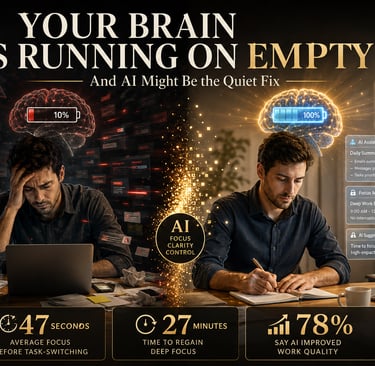
Here is something nobody tells you at the start of a busy workday: you are already losing. Before you open your first tab, before the notifications roll in, before your third coffee — your brain is wired for a world that no longer exists. A world with fewer pings, slower news cycles, and no infinite scroll designed by thousand-person engineering teams whose only job is to keep you looking.
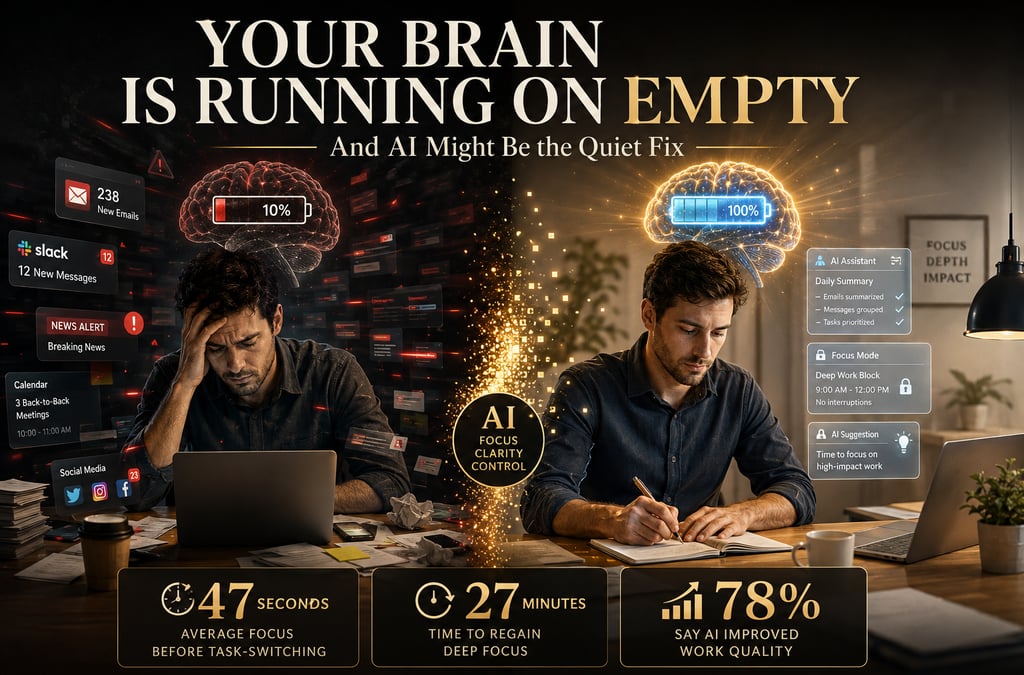
The numbers are brutal and worth sitting with. The average person today maintains focus on a single task for just 47 seconds before switching. In 2004, that number was two and a half minutes. We have not become lazier or less intelligent. We have become the targets of systems built specifically to fragment us — and those systems are very, very good at their job.
So where does AI fit into all of this? The honest answer is: it's complicated. AI helped build the attention economy that is eating us alive. Recommendation algorithms, personalised feeds, synthetic engagement loops — these are AI products. But something else is also true, and it deserves a fair hearing. Used deliberately, AI tools are now among the most effective weapons workers have for reclaiming deep focus. Not despite the crisis — because of it.
47sAverage focus before task-switching (2026)
27minTime to regain deep focus after one interruption
31%Attention improvement from structured focus programs
78%Gen Z workers say AI improved their work quality
The Problem Nobody Is Naming Correctly
When people talk about shrinking attention spans, they usually blame smartphones, social media, or "the kids these days." But that framing misses something important: this is not a willpower problem. It is an engineering problem. Platforms are designed — intentionally, with A/B tests and neural feedback loops — to interrupt you. The fact that the average person touches their phone 2,600 times a day is not a character flaw. It is the intended outcome of systems that profit from your divided attention.
What makes this especially corrosive at work is the recovery cost. Every time you are pulled off a deep task — by a Slack ping, a news alert, a colleague stopping by — your brain does not simply snap back. Research from Carnegie Mellon puts the average focus recovery time at 26.8 minutes. Workers who experience three or more interruptions per hour can take nearly 40 minutes to return to genuine deep work. Do the maths on a standard workday and the picture gets grim fast.
"It was like I had a dozen browser tabs open in my head, all fighting for attention. My thinking wasn't broken, just noisy — like mental static."
— Senior engineering manager, quoted in BCG research on AI and cognitive load, 2026
The tragedy is that we have normalised this state. Fractured attention has become the baseline. Workers do not know what sustained focus feels like anymore because they have not experienced it in years. This is the true scale of the crisis — not that people cannot focus, but that most have forgotten they ever could.
Where AI Actually Helps (And Where It Doesn't)
Let's be direct about something: AI will not save you if you use it the way most people do — as a crutch to produce more output faster while staying permanently distracted. That is not using AI. That is pouring accelerant on a fire.
But there is a different way to use it, and the difference is not subtle. The researchers at Psychology Today put it plainly in their 2026 analysis: AI is exceptionally good at what they call "shallow work" — drafting, summarising, organising, formatting, generating first drafts, scheduling. These tasks occupy somewhere between 30 and 60 percent of a typical knowledge worker's day. They require attention but not deep thought. And when AI handles them, something interesting happens: it does not just save time. It saves the specific kind of mental energy that deep work requires.
The key insight most people miss: Focus is not just about time — it is about cognitive energy. Spending 45 minutes on shallow tasks does not cost you 45 minutes of focus. It costs you the energy reserve you needed for the hard thinking you were saving for later. AI can protect that reserve. That is the real benefit.
Five Ways AI Is Quietly Rebuilding Attention at Work
Eliminating the "getting started" taxOne of the least discussed causes of attention failure is the cognitive effort of starting. Before you write a word of that report, you have already spent mental energy deciding how to begin, what tone to use, what structure makes sense. AI eliminates that friction entirely — it gives you a draft to react to, not a blank page to fill. Lowering the cost of beginning makes sustained work dramatically more accessible.
Turning interruption-magnets into summariesEmail, Slack, meeting notes — these are not just distractions in the moment. The anticipation of them is distracting. AI-generated summaries mean you can batch-process all of it in one focused 10-minute window rather than letting it seep into every hour of your day. Scheduled attention beats reactive attention every time.
Acting as a focus-aware schedulerAI calendar tools can now protect blocks of deep work time by declining low-priority meeting requests, clustering shallow tasks together, and flagging when your schedule has been colonised by interruptions. This is not a small convenience. It is the difference between a day where deep work happens and one where it keeps almost happening.
Reducing decision fatigue before it startsEvery micro-decision drains the same cognitive battery that focus runs on. What to write next. Which task to tackle first. How to phrase this email. AI can absorb hundreds of these small decisions per day, preserving the resource you actually need for work that matters.
Providing an intelligent nudge layerAI tools embedded in workflows can now detect when you have been in reactive mode too long and prompt you to return to deep work. They can summarise where you left off on a project, reducing the re-entry cost after any interruption. A 2026 study found that focus-first apps using these techniques reported 25 to 30 percent longer deep-work sessions among active users.
The Part That Requires Honesty
None of this works if you treat AI as a background noise machine running while you stay distracted. The benefit is not automatic. It requires a deliberate decision to use AI for offloading, not for adding more stimulation to an already overloaded day.
The workers who are genuinely reclaiming focus using AI share a common approach: they use it to do less, not more. They process faster so they can protect quiet time. They automate the predictable so they can show up fully for the unpredictable. They create margins in their day rather than filling them.
There is also a legitimate concern worth naming. When AI handles too much, the brain risks what researchers call "cognitive surrender" — a kind of learned helplessness where the effort of thinking feels disproportionate because AI has been handling it for so long. The answer is not to avoid AI. It is to be precise about which cognitive tasks you outsource and which ones you guard as non-negotiable.
More time for deeper thinking. Offloading the right tasks helps free up mental bandwidth for analysis and synthesis — the work that actually moves things forward.
— Research synthesis on AI and cognitive performance, 2025–2026
A Different Way to Think About This
The attention crisis is real. The numbers are not exaggerated. But the framing that positions AI as purely a threat to human focus is too simple to be useful. The same technology that built the trap is — in different hands, used differently — capable of helping dismantle it.
Think of it this way: a surgeon's scalpel can cause harm or perform miracles. The tool is not the story. The intention behind it is. AI used to maximise output while staying perpetually distracted will make the attention crisis worse. AI used deliberately to create space for deep thought is something genuinely worth having in your corner right now.
Your brain is not broken. It is under siege. And for the first time in a while, there is something in your toolkit that can help push back — if you are willing to be deliberate about how you use it.