YOUR APPS ARE ALREADY DEAD. THEY JUST DON'T KNOW IT YET.
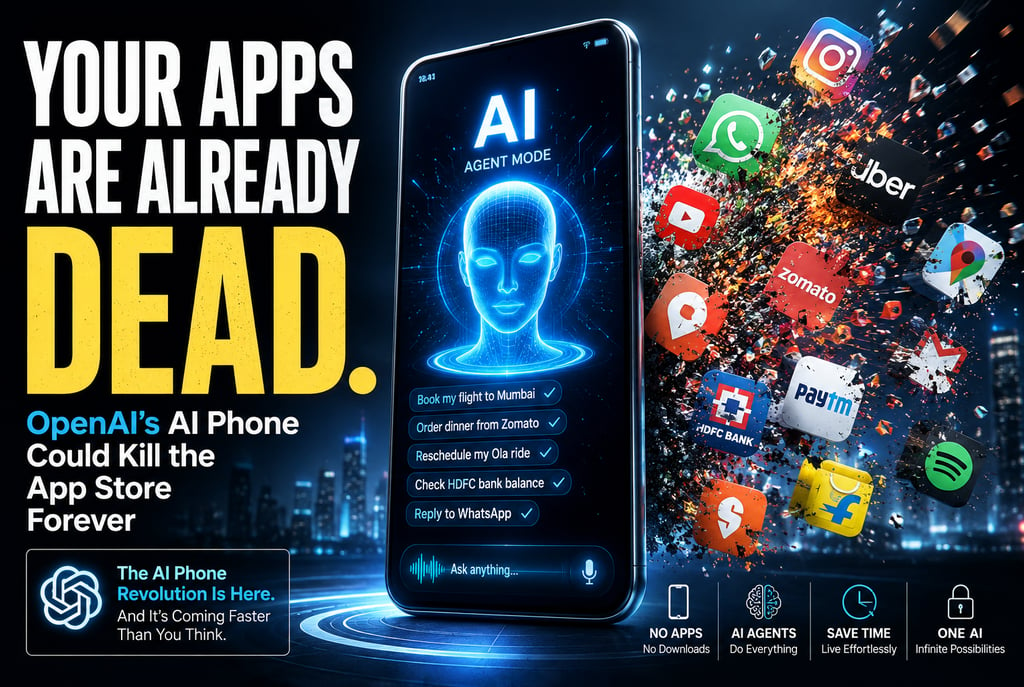
the biggest story in AI isn't a chatbot upgrade. It's a phone. An AI-first smartphone designed to erase the concept of apps entirely — replacing them with AI agents that think, plan, and act on your behalf.
Jyotsna
5/23/20263 min read
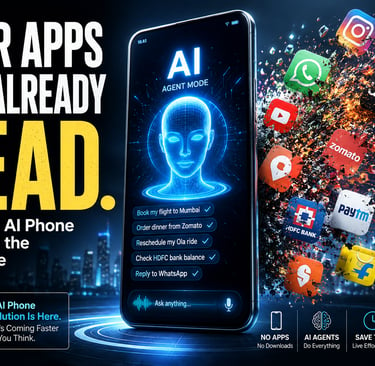
Remember the last time you opened your phone and counted how many apps you jumped through just to book a cab, check a flight, and confirm a hotel? Six apps. Fourteen taps. Thirty seconds wasted. Now imagine never doing that again — ever. That's the world OpenAI is building, and it might be the most disruptive thing in tech since the touchscreen itself.
the biggest story in AI isn't a chatbot upgrade. It's a phone. An AI-first smartphone designed to erase the concept of apps entirely — replacing them with AI agents that think, plan, and act on your behalf.
"Our intent with this collaboration was, and is, to create products that go beyond traditional products and interfaces." — Sam Altman, CEO, OpenAI
By The Numbers
30 Million — Units projected by 2028
$300 Billion — VC poured into AI startups in Q1 2026 alone
2028 — Mass production target date
So What Exactly Is Going On?
Top industry analyst Ming-Chi Kuo — the man who predicted the iPhone notch, AirPods Pro, and Apple Silicon — dropped a bombshell report. OpenAI is partnering with MediaTek, Qualcomm, and Chinese manufacturer Luxshare to build a device unlike anything you've ever held in your hand.
No app drawer. No Play Store. No App Store. Just a screen that's alive — powered by AI agents that handle your entire digital life. Book your Zomato order, reply to your WhatsApp, reschedule your Ola ride, check your HDFC balance — all through one AI. No switching, no loading, no confusion.
Why This Matters to YOU
Think about how many hours you lose every week jumping between 15 different apps. This phone is designed to give all of that time back — permanently.
Here's Why This Kills Everything You Know
01 — No More App Icons The home screen is replaced by a live AI feed of your tasks, appointments, and actions in progress. Your agent is already working before you even pick up the phone.
02 — AI Agents Cross App Boundaries Right now apps can't talk to each other without your help. An AI agent can use five services simultaneously to complete one task. Book flights + hotel + cab in one single sentence.
03 — Jony Ive Is Designing It The man who designed the iPhone, the MacBook Air, and the iMac is leading hardware design for OpenAI. This won't look like any phone you've ever seen.
04 — Apple and Google Are PANICKING Both companies are reportedly fast-tracking their own agentic AI layers. Google even shut down its internal AI project "Mariner" and is rebuilding from scratch with renewed urgency.
05 — Your Subscription Replaces the App Store OpenAI may bundle hardware + AI access into one monthly subscription. No individual app purchases. No in-app payments. One fee. Everything included.
But Wait — Could This Actually Fail?
Let's be real. This is still a rumor, not a confirmed product. Specs are expected to be locked down by late 2026 or early 2027 — with mass production only starting in 2028. That's a long runway.
And there's a real problem nobody's talking about — the global memory chip shortage. Running powerful AI agents 24/7 on a mobile device requires enormous memory bandwidth. The current chip supply chain — already strained by AI data centers — may struggle to deliver the components needed at scale. One wrong move and the entire launch could be delayed by years.
Reality Check: OpenAI has NOT officially confirmed a smartphone. These reports are based on supply chain analyst intelligence and industry sources. But when Ming-Chi Kuo speaks, the tech world listens — his track record is almost unmatched.
What This Means For India & You
India is the world's second-largest smartphone market with over 750 million users. Every major AI company — OpenAI, Google, Meta — has India squarely in its growth plans.
Think about how transformative this could be for a first-time smartphone user. Instead of learning 20 different apps, they simply talk to their phone and it handles everything. Banking. Healthcare. Education. Transportation. In Hindi, Tamil, Bengali — in their own language, naturally.
The 3 Big Questions Everyone's Asking
Will it replace the iPhone? Not immediately. But it doesn't need to. It just needs to make millions of people wonder why they're still juggling apps — and that's already a win for OpenAI.
What happens to app developers? Apps don't die — they become invisible infrastructure. Your Swiggy app still exists, but you never open it. The AI calls it for you. Developers will need to build "agent-friendly" APIs or get left behind.
When can I actually buy it? If timelines hold, 2028 is the realistic year. But OpenAI's first hardware announcement is expected in the second half of 2026 — and that alone will change the conversation forever.
Final Verdict
The App Era Is Ending. The Agent Era Has Begun.
Whether OpenAI's phone ships in 2028 or 2030, the direction is crystal clear. AI agents are replacing apps. The smartphone you carry in your pocket will look completely different within five years. The only question is: who builds it first — and whether you're ready for a world where your phone thinks for you.
Ready to copy-paste anywhere — Medium, LinkedIn, your website, or Instagram caption format. Want me to also write a short LinkedIn post or Instagram caption version of this to go along with it?