Why AI Automation and WhatsApp Chatbots Are the Two Most Powerful Tools for Business Growth in 2026
From agentic workflows to conversational commerce on WhatsApp — here's everything you need to know, the keywords people are searching, and how your business can win big this year.
AI AUTOMATION
JYOTSNA
5/25/20269 min read
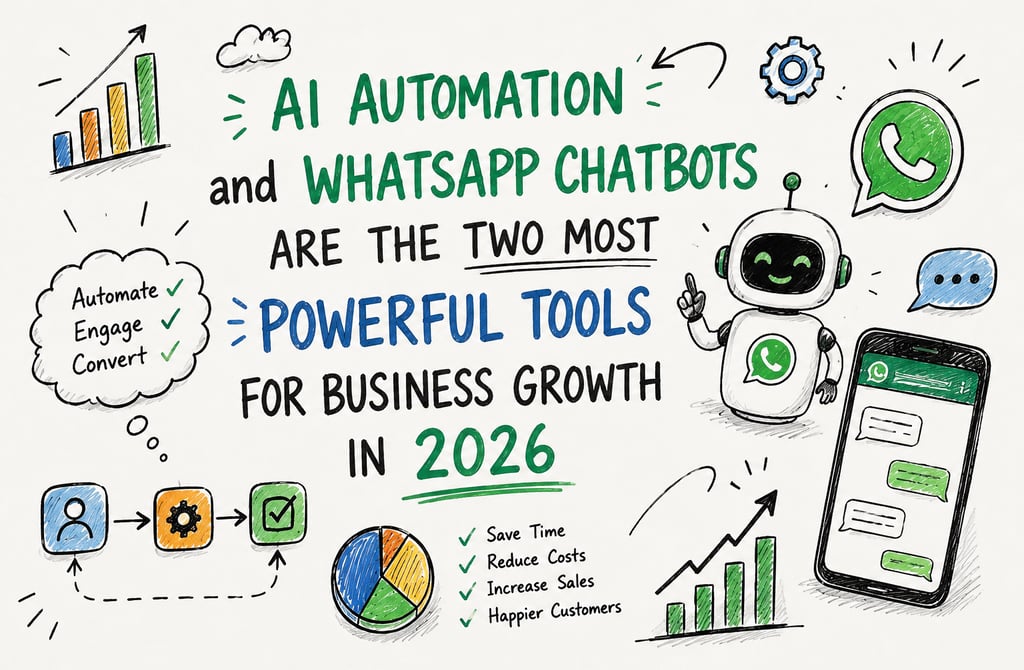
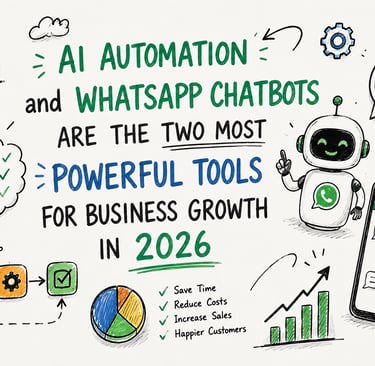
There is a quiet revolution happening right now inside millions of businesses — and most of them don't even realize it. The way customers are found, engaged, supported, and converted has fundamentally changed. Two forces are driving this change harder than anything else: AI automation and AI-powered WhatsApp chatbots. Together, they are rewriting the rules of business growth in 2026.
If you've been searching for terms like 'AI automation tools 2026', 'WhatsApp chatbot for business', or 'no-code AI automation' — you're not alone. These are among the fastest-growing search queries on the internet right now. And there's a very good reason why. Businesses that have implemented these technologies are reporting dramatic improvements in customer response times, lead conversion, revenue, and operational efficiency.
In this comprehensive guide, we'll break down what AI automation really means in 2026, why WhatsApp chatbots have become a primary business channel (especially in India), what keywords and strategies are trending right now, and — most importantly — how you can put all of this to work for your own business.
693%Increase in AI-driven retail traffic (Adobe 2025)
70%Businesses report better customer satisfaction with AI WhatsApp bots
128%YoY growth in commercial AI search keywords
65%Businesses report strong ROI from WhatsApp marketing
— ✦ —
Part OneWhat Is AI Automation — And Why Is Everyone Searching for It?
Let's start with the basics, because there's a lot of confusion around what 'AI automation' actually means. In 2024, it meant scheduling social media posts or auto-replying to emails. In 2026, it means something far more powerful. AI automation today refers to intelligent, self-directed systems that can plan tasks, make decisions, use tools, and execute entire workflows — all without a human being present.
Think about what that means in practice. A business owner wakes up in the morning and their AI agent has already — overnight — responded to 200 customer enquiries, qualified 40 leads, updated the CRM, sent follow-up messages to warm prospects, and generated a performance report. That is not a fantasy. That is happening right now for businesses that have embraced agentic AI automation.
'The most searched AI automation keywords in 2026 are no longer about simple task automation. They're about autonomous AI agents that act, decide, and deliver results.'— Industry Analysis, May 2026
The Keywords People Are Searching Right Now
If you're building content, running ads, or trying to reach businesses looking for automation solutions, these are the exact phrases your audience is typing into search engines and AI tools:
Hottest AI Automation Keywords — 2026
AI automation tools 2026agentic AI automationAI workflow automationno-code AI automationAI agent for businessgenerative AI automationAI process automationLLM automation pipelineAI search automationcommercial AI automationAI for small business Indiaautomate business with AI
The Three Levels of AI Automation in 2026
Level 1 — Task Automation: The most basic form. Think auto-replies, scheduled posts, and form fills. This is table-stakes now. Every business should have this. If you're still manually doing tasks that a simple rule-based system could handle, you're already falling behind.
Level 2 — AI Workflow Automation: This is where it gets interesting. Multiple steps, multiple tools, connected together. For example: a customer fills a form → AI qualifies the lead → sends personalised follow-up → books a calendar slot → notifies the sales team. The whole thing runs without a single human click. Tools like Zapier AI, Make (formerly Integromat), and n8n are powering this space.
Level 3 — Agentic AI: This is the frontier. AI agents that can browse the web, write and send emails, update databases, analyse reports, and even make purchases on behalf of users. McKinsey noted in 2025 that LLMs are beginning to evolve into agents that make purchasing decisions automatically on behalf of users — and this is now becoming mainstream in 2026.
Most small and medium businesses are currently operating at Level 1, dabbling with Level 2, and hearing a lot about Level 3. The opportunity is enormous for those who move quickly.
Part TwoAI WhatsApp Chatbot: The Business Channel That's Dominating 2026
Now let's talk about the technology that is arguably having an even bigger impact on business growth — at least in markets like India, Southeast Asia, and Latin America. The AI WhatsApp chatbot has evolved from a novelty to an absolute necessity. And the numbers prove it.
WhatsApp is not just a messaging app anymore. In 2026, it is a complete business channel. Businesses are using it for customer support, sales, lead generation, appointment booking, order updates, marketing campaigns, and even completing transactions — all within the chat window.
'WhatsApp is no longer just where people chat with friends. It's where they shop, get support, and make decisions. Any business not on WhatsApp is invisible to a huge portion of their market.'— Conversational Commerce Report, 2026
Why WhatsApp? The Raw Numbers
WhatsApp has over 2 billion active users globally. In India alone, it has over 500 million users. Open rates for WhatsApp messages sit at an extraordinary 98% — compared to email's average of 20–25%. Response rates are similarly staggering. When a business reaches a customer on WhatsApp, that customer actually reads it.
And here's what makes AI WhatsApp chatbots genuinely transformative: they allow a single business to have thousands of personalised, intelligent conversations simultaneously, 24 hours a day, 7 days a week — without hiring a single additional team member.
The Keywords People Are Searching — WhatsApp Chatbot
💬 Hottest WhatsApp Chatbot Keywords — 2026
AI WhatsApp chatbot for businessWhatsApp automation 2026WhatsApp Business API chatbotno-code WhatsApp chatbotWhatsApp chatbot for ecommerceWhatsApp AI customer support botWhatsApp lead generation botWhatsApp drip campaign automationWhatsApp CRM integrationWhatsApp conversational commerceWhatsApp chatbot IndiaAiSensy vs Wati India
Part ThreeHow AI WhatsApp Chatbots Actually Work (And What Makes a Great One)
There's a big difference between a basic WhatsApp bot and a truly intelligent AI WhatsApp chatbot. Understanding this difference is crucial before you invest time or money into building one.
Rule-Based Bots vs. AI-Powered Bots
The old generation of WhatsApp bots were entirely rule-based. They worked like decision trees: if a customer typed 'price', send the price list. If they typed 'support', send a phone number. These bots were rigid, frustrating, and quick to break the moment a customer said something even slightly unexpected.
Modern AI WhatsApp chatbots work entirely differently. They use Natural Language Processing (NLP) to understand what a customer is actually trying to say — regardless of how they say it. A customer might type 'how much does it cost?', 'what's ur price bro', or 'bhai kitna paisa lagega' — and a well-built AI chatbot understands all three as the same question and responds appropriately.
Beyond understanding language, today's AI chatbots can maintain context throughout long conversations, remember what was said earlier, integrate with your CRM and inventory systems in real time, and intelligently hand over to a human agent when the conversation requires it.
✅ 7 Things the Best AI WhatsApp Chatbots Do in 2026
Understand intent — not just keywords. They know what a customer means even when phrased awkwardly.
Maintain context — they remember the earlier parts of the conversation and don't make customers repeat themselves.
Integrate with CRM — they can pull customer data, check order status, and update records in real time.
Run drip campaigns — automated follow-up sequences that nurture leads over days or weeks.
Qualify leads automatically — ask the right questions, score the lead, and route hot leads to sales instantly.
Support multiple languages — critical for India. Hindi, Punjabi, Tamil, Bengali — the best bots handle them all.
Escalate smartly — know when to hand over to a human, and do it with full context intact.
The WhatsApp Business API — What You Need to Know
To build a serious AI WhatsApp chatbot for business, you'll need access to the WhatsApp Business API. This is different from the regular WhatsApp Business app. The API allows you to connect WhatsApp to your systems, automate at scale, and use third-party platforms to build sophisticated chatbot flows.
Getting access to the API requires going through a Meta-approved Business Solution Provider (BSP). Platforms like Wati, AiSensy, Interakt, Gupshup, and others serve as intermediaries that make this process manageable — especially for small and medium businesses that don't have large technical teams.
Part FourThe Best AI WhatsApp Chatbot Platforms in 2026 — Compared
With so many options in the market, choosing the right WhatsApp chatbot platform can feel overwhelming. We've broken down the top options based on ease of use, AI capabilities, pricing, and suitability for different business types — especially for the Indian market.
For most small and medium businesses in India, AiSensy and Wati are the top starting points because they offer easy setup, Hindi support, and pricing that makes sense for the Indian market. If you have a development team and want maximum flexibility, Botpress is worth the steeper learning curve.
🇮🇳 Special Focus: AI WhatsApp Chatbot for Indian Businesses
India is one of the biggest WhatsApp markets in the world — and also one of the fastest-growing markets for AI automation. If you're a business in India, the opportunity is staggering. India's WhatsApp commerce GMV crossed ₹2.5 lakh crore in 2025 — and it's growing faster than almost any other digital commerce channel in the country.
The most searched keywords from Indian users specifically include: 'WhatsApp chatbot India', 'AI chatbot for small business India', 'WhatsApp automation for Shopify India', 'AiSensy vs Wati India', and 'WhatsApp business bot Hindi'. If you're targeting Indian customers, these are the exact phrases to build your content and ad campaigns around.
Whether you run a clothing store in Ludhiana, a coaching institute in Delhi, or an electronics shop in Mumbai — a well-built WhatsApp AI chatbot can transform how you acquire and retain customers.
Part FiveCombining AI Automation with WhatsApp Chatbots — The Real Power Move
Here's where things get genuinely exciting. Most businesses use AI automation and WhatsApp chatbots as separate tools. The businesses that are growing the fastest are the ones that have combined them into a single, integrated system. And the results speak for themselves.
Imagine this scenario: A potential customer sees your Instagram ad, clicks it, and is taken to a landing page. They enter their WhatsApp number. Immediately, your AI WhatsApp chatbot sends them a personalised greeting, asks a few qualifying questions, and — based on their answers — the AI workflow automation system categorises them as a hot lead, adds them to your CRM, sends the lead to your sales team on WhatsApp, and simultaneously starts a 7-day drip campaign of helpful content.
If the lead doesn't respond within 24 hours, the system automatically sends a gentle follow-up. If they reply at 2am, the bot handles it. If they're ready to buy, the bot can take the order, send a payment link, confirm the order, and update your inventory system. All automatically. All while you sleep.
'The businesses winning in 2026 are not the ones with the biggest teams. They're the ones with the smartest automated systems working around the clock.'— AI Business Strategy Report, 2026
The AI Automation Stack That Works
If you're building this kind of system, here's a practical stack that works for most businesses:
Lead capture: Facebook/Instagram ads or a website form → WhatsApp opt-in
Chatbot layer: Wati, AiSensy, or Botpress for WhatsApp conversations
Automation backbone: Make (Integromat) or Zapier to connect everything
CRM: HubSpot, Zoho, or even a simple Google Sheets setup for smaller businesses
AI layer: GPT-4 or Claude API integrated into your chatbot for intelligent responses
Analytics: Track open rates, response rates, conversion rates, and ROI by campaign
Part SixThe Common Mistakes Businesses Make With AI Automation & WhatsApp Chatbots
For all the excitement around AI automation and WhatsApp chatbots, there are also some very common mistakes that businesses make — mistakes that turn potentially powerful tools into frustrating, expensive failures. Let's talk about them honestly.
Mistake 1: Treating the Bot Like a Brochure
Many businesses set up a WhatsApp chatbot that does nothing more than send their price list and ask customers to call. That's not a chatbot — that's a digital pamphlet. The power of a WhatsApp AI chatbot lies in having real, two-way, intelligent conversations. If your bot can't ask follow-up questions, handle objections, and adapt to what the customer says, you're wasting the technology.
Mistake 2: No Human Fallback
An AI WhatsApp chatbot must always know when to hand over to a human being. Complex complaints, angry customers, large transactions, and sensitive issues all require a human touch. The best bots escalate intelligently — passing full conversation history to the human agent so the customer doesn't have to repeat themselves.
Mistake 3: Over-Automation Without Personalisation
Automation that feels robotic damages your brand. The best AI chatbot systems are ones where customers don't even realise they're talking to a bot — or if they do, they don't mind because the experience is smooth, helpful, and responsive. Use your customer's name. Reference their past purchases. Respond to their specific question, not a generic version of it.
Mistake 4: Ignoring Analytics
Your WhatsApp chatbot is generating extraordinarily valuable data about your customers — what they ask, what they worry about, where they drop off, what converts them. Most businesses set up the bot and never look at the data. Don't make this mistake. Review your chatbot analytics weekly and use the insights to improve your flows, your offers, and your messaging.
Mistake 5: Starting Too Complex
The most common reason businesses fail with AI automation is trying to build too much, too fast. Start with one use case. Customer support FAQs. Lead qualification. Order status updates. Do that one thing brilliantly before adding complexity. Crawl, then walk, then run.
Part SevenSEO Strategy: How to Rank for AI Automation & WhatsApp Chatbot Keywords
If you're a business selling AI automation services, WhatsApp chatbot solutions, or digital marketing services — understanding how to rank for these keywords is critical. Here's the honest truth about SEO in 2026.
The old approach of stuffing keywords into blog posts and hoping for the best is dead. In 2026, AI search has fundamentally changed how content gets discovered. Tools like ChatGPT, Perplexity, and Google's AI Overviews now answer users' questions directly — without them ever clicking a link. This means your goal is no longer just to rank; it's to be cited by AI search engines as a trusted source.
How to Get Cited by AI Search Engines
To be referenced by AI-powered search tools, your content needs to be authoritative, specific, and genuinely useful. Here's what that looks like in practice:
Answer real questions clearly. AI search tools look for content that directly and comprehensively answers the questions users are asking. Instead of writing 'AI automation is important for businesses', write 'Here's exactly how to set up an AI workflow automation for your ecommerce store in 3 steps.'
Build topical authority. Don't just write one blog post about WhatsApp chatbots. Build an entire content cluster — beginner guides, platform comparisons, case studies, how-to tutorials, FAQs. AI tools recommend sources that cover a topic deeply, not superficially.
Earn mentions across the web. AI search engines look at brand mentions across third-party sites, forums, reviews, and publications. A consistent brand presence across LinkedIn, YouTube, industry publications, and communities signals authority.