WHAT IS AGENTIC AI — AND WHY EVERYONE IS TALKING ABOUT IT
In 2026, we're past that. Agentic AI is the shift that actually matters. Instead of just answering questions, AI agents can now do things — browse websites, write and execute code, send emails, fill forms, book meetings, and chain together dozens of tasks without a human approving each step.
AI AUTOMATION
JYOTSNA
5/27/202610 min read
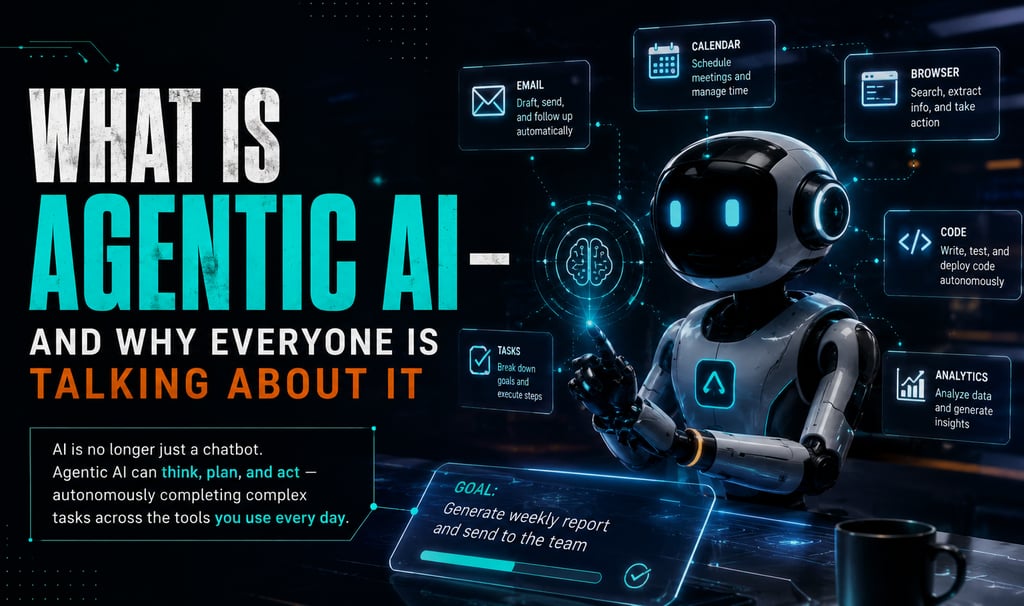
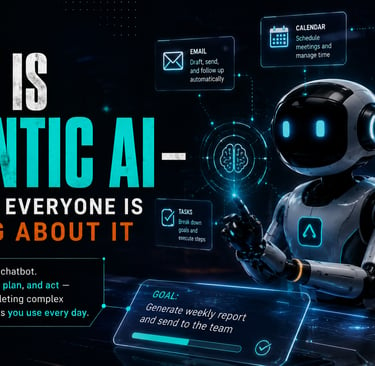
A year ago, AI was a chatbot. You typed something. It replied. You copied and pasted. That was the loop. Useful, sure. But not transformative.
Think of it this way: the old AI was a very smart assistant who could only answer questions. The new AI is that same assistant — except now they have hands.
Autonomous task chains. An AI agent doesn't just answer "write a follow-up email" — it finds the lead in your CRM, checks their last interaction, drafts the email, personalises it, and sends it. All without you touching it.
Tool use is everything. The key breakthrough: AI models can now use external tools — web browsers, code interpreters, APIs, databases — as part of their reasoning process. This is what makes agents actually useful.
Memory and context. 2026 agents maintain memory across sessions. They know your previous conversations, your preferences, your workflow. They get better with time — like an employee, not a tool.
Multi-agent systems. The frontier in mid-2026 is AI agents that hire and manage other AI agents. One orchestrator agent, multiple specialist sub-agents. Finance. Content. Customer support. All running in parallel.
No-code access. You don't need to be a developer. Platforms like Make.com, Zapier AI, and Lindy have made no-code AI automation real. If you can describe what you want done, an agent can do it.
"The question in 2026 is not whether to use AI automation. It's whether you'll be the one using it — or the one replaced by someone who does."
— Common consensus across every serious tech conference this year
● ● ●
Section 02
THE BIG FOUR: CHATGPT, GEMINI, CLAUDE & PERPLEXITY — COMPARED HONESTLY
Here's what nobody tells you: there is no single best AI tool in 2026. Every major model has a different strength. The people winning with AI are using multiple tools for different jobs — not betting everything on one. Here's the honest breakdown.
The most capable general-purpose AI in 2026. GPT-5.5 powers ChatGPT's Operator mode — an agent that can literally browse the web, fill out forms, and complete multi-step tasks autonomously. Best for: automation, coding, complex reasoning, business workflows.
Google · Real-time Agent
Google's fastest model — ultra-lightweight, built for real-time tasks inside Google Workspace. Powers AI Overview in Google Search. Native integration with Gmail, Docs, Calendar. Not the smartest in deep reasoning but the fastest at quick browser-based tasks. Best for: Google ecosystem, speed, AI SEO 2026.
Anthropic · Long Context
Anthropic's model is the most nuanced writer in the game. Best at long-document analysis, careful reasoning, and producing human-sounding content. Anthropic's $900B valuation tells you the industry takes it seriously. Claude Code is also the #1 agentic coding tool in terminals right now. Best for: writing, documents, coding, safety-critical outputs.
The newest Google release — multimodal from the ground up. Processes text, images, audio, and video in a single context window. The fastest LLM of 2026 for mixed-media tasks. Breakout growth in June–July 2026. Best for: image analysis, video understanding, multimodal pipelines.
The research engine that threatened Google's search monopoly. Perplexity gives you real-time web answers with citations — no hallucinations, all sources shown. In 2026 it launched an agentic "Deep Research" mode that produces full reports autonomously. Best for: research, fact-checking, competitive analysis.
Best for Research
HEAD-TO-HEAD: GPT-5.5 vs Claude vs Gemini 3.5 Flash
● ● ●
Section 03
HOW AI WORKFLOW AUTOMATION ACTUALLY WORKS IN 2026
The term "AI automation" gets thrown around so much it's started to lose meaning. Let's make it concrete. Here are the five most powerful AI workflow automation patterns that businesses are using right now — and how to implement each one.
The 5 Automation Patterns You Need to Know
→
Trigger → AI → Action. The simplest pattern. Something happens (new email arrives, form submitted, order placed) → AI processes it (summarises, classifies, generates a response) → Action fires (CRM updated, reply sent, Slack message sent). This is 80% of what Make.com and Zapier AI do. Start here.
→
AI Content Pipeline. Input is a brief or URL → AI researches, writes, formats, and publishes. In 2026, this runs at scale. A single content pipeline can produce 50 SEO articles per week — researched, written, formatted, and scheduled — with one human reviewing and approving before publish.
→
Customer Support Agent. An AI agent that handles tier-1 support: reads the ticket, checks the knowledge base, checks the order history, drafts a personalised resolution, and sends it — or escalates with a full brief to a human when it can't solve it. Most companies cut support volume by 40–60% with this.
→
Sales Automation Loop. Lead comes in → AI scores them → AI personalises an outreach email → AI follows up based on open/click behaviour → AI books a meeting. Human only shows up for the call. Sales teams using this in 2026 report 3× more pipeline with the same headcount.
→
AI Coding Assistant Pipeline. For engineering teams: AI reviews pull requests, writes test coverage, generates documentation, and suggests refactors. Claude Code in the terminal is the dominant tool for this. Cuts code review time by ~60% in most teams.
How to Start — In 30 Minutes — With No Code
Pick one repetitive task you do every week
Not "automate my whole business." One task. Sending a weekly report? Following up on leads? Summarising meeting notes? Start there. The simpler the better.
Open Make.com or Zapier — create a free account
Both have AI layers built in. Make.com is more powerful for complex automations. Zapier is easier for simple ones. You don't need to code anything. Everything is drag-and-drop.
Connect your apps — Gmail, Slack, CRM, calendar
Both platforms have 500+ integrations. Connect the apps involved in your chosen task. Takes about 5 minutes per app. Most connections are one-click OAuth.
Add the AI step — describe what you want in plain English
Both platforms let you type what the AI should do: "Summarise the email and reply with a warm acknowledgement." No prompting skills required. It just works.
Test it once. Then run it forever.
Run a test with real data. Check the output. Tweak the prompt if needed. Turn it on. That task now happens automatically — every time, on time, without you thinking about it again.
● ● ●
Section 04
WILL AI REPLACE YOUR JOB? THE HONEST ANSWER IN 2026
This is the question everyone is actually asking but nobody wants to say out loud. So let's just say it out loud.
AI is replacing tasks. Not jobs. Yet. The distinction matters enormously. If your job is 90% one repeated task — data entry, basic copywriting, tier-1 customer support — you are at meaningful risk within the next 24 months. If your job is a collection of different skills, judgment calls, and human relationships, you are not at immediate risk. But you will be left behind if you don't learn to use AI to amplify yourself.
High displacement risk: Data entry clerks, basic copywriters, tier-1 support agents, report generators, transcriptionists, basic translators. AI automation in 2026 handles all of these at scale, cheaply.
Medium displacement risk: Junior developers, junior designers, paralegal researchers, entry-level financial analysts. AI does the grunt work — humans do the judgment calls. These roles are shrinking in headcount but growing in leverage per person.
Low displacement risk: AI trainers, prompt engineers, automation architects, senior developers, creative directors, therapists, teachers, managers, salespeople. These roles are growing. The humans who work with AI earn more than those who don't — the gap is widening fast.
The real opportunity: The fastest-growing skill in the job market in 2026 isn't a specific software — it's knowing how to get AI to do what you want. That's it. The people who can direct AI effectively are 5–10× more productive than those who can't. That's the moat. Build it.
⚠ Reality check: The Magnifica Humanitas AI encyclical (2026) — the Catholic Church's first formal AI ethics document — explicitly warns against treating AI displacement as inevitable fate. The framing matters: AI as tool vs. AI as replacement is a choice we make in how we deploy it.
● ● ●
Section 05
AI SEO 2026: HOW TO RANK IN THE AGE OF AI OVERVIEWS
Google's AI Overview — powered by Gemini Spark — now appears on the first screen for nearly 9 out of 10 searches. If you're not in it, you're not visible. Here's how SEO has fundamentally changed and what you need to do about it.
01
E-E-A-T is everything now. Experience, Expertise, Authoritativeness, Trustworthiness. Google's AI Overview cites sources that demonstrate real-world experience. Write from experience. Show your credentials. Link to your real profiles. First-person experience beats third-person summary every time.
02
Answer the question in the first sentence. AI Overview pulls the most direct, clear answer to the query. Your content needs to lead with the answer — then explain it. Not the other way around. Stop burying the lede.
03
Structured content wins. Headers, bullet points, numbered lists, tables, FAQs. Gemini's crawlers extract structured content easily. A wall of text is a hard pass. Break everything up into scannable chunks with clear headers.
04
Schema markup is not optional anymore. Article schema, FAQ schema, Product schema, HowTo schema — these tell Google's AI exactly what your content is about. Sites with schema are cited in AI Overviews at 3× the rate of sites without it.
05
Long-tail questions are goldmines. Average search length in 2026 is now 12+ words because people are typing conversational queries like they talk to ChatGPT. "How do I automate email marketing with AI for free" beats "email automation" for conversion rate and AI Overview citation rate.
The AI Content Creation Trap — And How to Avoid It
Here's the uncomfortable truth about AI content creation in 2026: Google is getting better at detecting it. Not to penalise AI-written content per se — but to penalise content with zero original perspective. Thin content is thin content, regardless of who (or what) wrote it.
The winning formula is: AI for research and structure, human for perspective and experience. Use GPT-5.5 or Claude to pull together information, suggest structure, and fill gaps. Then add your own voice, your real-world examples, your genuine opinion. That combination — human insight structured with AI efficiency — is what Google's quality raters look for in 2026.
● ● ●
Section 06
THE OPENAI IPO & ANTHROPIC VALUATION — WHY IT MATTERS FOR YOU
If you follow AI at all, you've seen the numbers. Anthropic's valuation reached $900 billion in early 2026 — making it one of the most valuable private companies in history, despite never having turned a profit. OpenAI's IPO has been the most anticipated financial event in tech in years.
Why should a non-investor care? Because these numbers tell you something important about the trajectory: the world's smartest money is betting that AI automation becomes as fundamental as electricity within the next decade. That kind of capital concentration accelerates everything — more compute, faster model releases, cheaper APIs, better tools. What costs ₹10,000/month today to run as an AI workflow will cost ₹500/month in 18 months. That's the curve you're on.
→
Anthropic ($900B valuation): Amazon and Google are both major investors. Claude is deployed across thousands of enterprise products. The Anthropic valuation reflects the market's belief that safety-focused AI wins long-term enterprise trust — the biggest market of all.
→
OpenAI IPO: When it happens, it will be the largest tech IPO since Meta. The capital raised goes directly into compute — which means faster GPT releases, cheaper API pricing, and more capable agents. For businesses: prices go down, capabilities go up.
→
Apple + Gemini partnership: Apple quietly integrated Gemini into its on-device AI layer alongside its own models. This means 2 billion iPhone users now have agentic AI built into their phones. The mainstream adoption curve just got a lot steeper.
→
Meta AI agent 2026: Meta launched its own standalone AI agent across WhatsApp, Instagram, and Facebook — with 3 billion users immediately addressable. Social media AI automation is about to change every brand's social strategy completely.
● ● ●
Section 07
AI FOR MARKETING IN 2026 — WHAT'S ACTUALLY WORKING
If you're in marketing in 2026 and you're not using AI tools, you're doing 10 hours of work that your competitor is doing in 2. That's not a metaphor. Here's what is genuinely working right now for marketers using AI:
✓
AI-written, human-edited content at scale. Claude or GPT-5.5 drafts blog articles from a brief. A human editor adds real insight, edits tone, and approves. Output: 10 quality articles per week instead of 2. The model doesn't replace the writer — it eliminates the blank page.
✓
Personalised email sequences. AI agents write personalised follow-up emails for each lead based on their specific behaviour — what they clicked, what they read, what they downloaded. Click-through rates are 2–3× higher than template emails.
✓
AI image generation for social. Midjourney, Flux, and Adobe Firefly produce on-brand social visuals in minutes. Brands running 21+ posts per week are doing it with 1 designer + AI tools — what used to require a 5-person creative team.
✓
Competitor monitoring agents. Perplexity AI-powered agents that monitor competitor content, pricing changes, and news mentions — and send you a weekly brief. Replaces a full-time research analyst for small teams.
✓
AI SEO 2026 audits. Tools like Ahrefs AI and Semrush Copilot audit your site, identify content gaps, suggest new articles targeting AI Overview keywords, and prioritise fixes by traffic impact. What used to take a 2-hour SEO session now takes 10 minutes.
● ● ●
Section 08
FREQUENTLY ASKED QUESTIONS
Q What is agentic AI and how does it work for beginners?
Agentic AI is an AI system that can take actions — not just answer questions. Instead of replying to a prompt, an AI agent can browse the web, write code, send emails, book meetings, and chain tasks together without human approval at each step. Think of it as the difference between asking someone a question and hiring someone to do the job. In 2026, tools like ChatGPT Operator, Claude Code, and Google's Gemini Spark all have agentic capabilities.
Q Which is better in 2026 — ChatGPT (GPT-5.5) or Claude?
Both are excellent but for different things. GPT-5.5 leads in agentic tasks, coding, and integrations — it's the go-to for complex automations. Claude leads in writing quality, long-document analysis, and nuanced reasoning. For most businesses: use GPT-5.5 for automation pipelines and Claude for writing and analysis. Using both via API gives better results than choosing one.
Q How to use AI automation to grow my business in 2026?
Start small. Pick one repetitive task — lead follow-up, weekly report, customer support FAQ — and automate it using Make.com or Zapier AI. No coding required. Once it works, expand. The businesses growing fastest in 2026 aren't the ones with the biggest AI budgets — they're the ones who automated 10 small things and freed up 20 hours a week to focus on what only humans can do.
Q Will AI replace software developers' jobs in 2026?
Not replace — compress. AI coding assistants (Claude Code, GitHub Copilot, Cursor) are eliminating the boilerplate and grunt work. One senior developer with AI tools now does what 3 junior developers did in 2024. Junior developer roles are fewer. Senior developers with AI skills earn significantly more. If you're a developer, the move is to become excellent at directing AI to do the mechanical work while you focus on architecture, judgment, and complex problem-solving.
Q How to rank on Google AI Overview with AI content in 2026?
Write with genuine first-person experience. Lead with the direct answer. Use structured headers and bullet points. Add FAQ schema and Article schema markup. Target conversational long-tail keywords that match how people actually search in 2026. Most importantly: add your own perspective and experience — Google's AI Overview consistently prefers sources that demonstrate genuine expertise over thin, generic content.
Q What is the best AI productivity tool for 2026?
It depends on what you're trying to do. For writing and research: Claude or Perplexity AI. For automation workflows: Make.com with ChatGPT API. For coding: Claude Code or Cursor. For real-time Google-integrated tasks: Gemini Spark. For multimodal tasks (images, video): Gemini 3.5 Flash. Most power users in 2026 use 3–4 tools with different specialisations rather than relying on one.