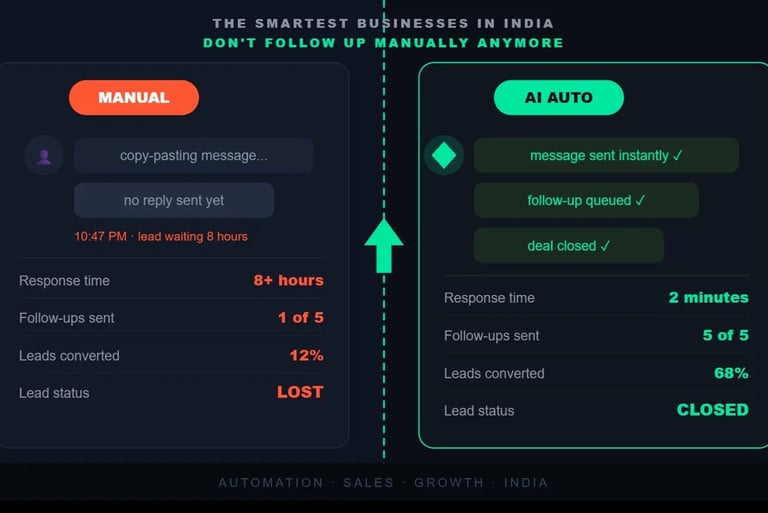
The Smartest Businesses in India Don't Follow Up Manually Anymore.
Most business owners aren't running a business. They're running themselves into the ground — manually doing things a system could handle in seconds.
AI AUTOMATION
Jyotsna
4/15/20263 min read
When your sales team begin copy-pasting WhatsApp messages at 10 PM, your competitors have already completed the deal - automatically.
There is one thing that I have witnessed happening again and again to Indian businesses, such as a small real estate agency in Pune or a mid-sized e-commerce brand in Delhi. They spend lakhs in Google Ads, recruit three sales men and make 200 leads in a month. Then they lose 70% of them.
Not due to the poor quality of their product. Not necessarily due to the price. They lost them since nobody adhered to time.
The lead was received at 2 PM, The salesperson was busy with another call. They returned at 4:30 PM, and by that time, this potential customer had already called a competitor, who answered within 4 minutes.
This is the leakage in most Indian businesses that cannot be seen. And the most intelligent have learned how to correct it - without increasing the number of people.
The Follow-Up Issue, No One Speaks About.
India boasts of one of the fastest-growing digital consumer bases worldwide. Yet there is a weird disconnection, whereby businesses invest a lot of money to get leads and almost nothing is done to develop the leads.
Imagine the last time you asked something online, say a coaching program, a house, a software program. How many of those companies returned the same day? What was the number who made follow-ups twice? How many of them sent you a helpful message three days later on why they were the right choice?
Probably very few. And this is precisely the challenge where intelligent businesses are triumphing currently.
What Follow-Up Costs You (Manual)
This cost is underestimated by most business owners since it does not appear anywhere in an invoice in form of a line item. But it's real.
When you rely on your salesperson to follow up manually, the following is what happens:
Follow-ups on leads are inconsistent - 5 calls follow some, 1 forget others.
The quality of follow up is based on the mood, energy, and bandwidth of your team that day.
There are no follow-ups during weekends, late nights or during team leaves when most customers are in fact browsing.
You are not visible who was called and when, what was said.
Your top salespeople are exhausted working on monotony, rather than making warm deals.
"Manual follow-up is not only time-consuming, but it also results in a disjointed customer experience that will build up mistrust in your brand over time.
The Process of How Automated Follow-Up Works.
It is in this area that most business owners make a mistake by believing that automation can only mean robotic and impersonal messages. Cold. Corporate. The type that causes you to shudder.
That's not what we're talking about.
Smart follow-up automation is concerned with the idea of delivering the right message, to the right person, at the right time, automatically. It is personal since it is brought about by behavior. It is timely as it does not require a human to remember to do it.
An effective automated follow up system is as follows: A lead completes a form on your site at 11 PM. They are then sent a WhatsApp message, in which they are informed of their inquiry and an assurance of a call back in the morning, within 2 minutes. Your salesperson receives a notification of the lead with the details of the lead at 9 AM, and the lead is warm and willing to close. Three days without a response of the lead - another automated touchpoint is sent down, perhaps a case study or a special offer. All this did not have to be remembered by a human being.
It is not intended to substitute your sales team. It's to make them 3x more productive by giving them warm conversations to make — rather than cold leads that they need to pursue.
Where to Start?
Suppose you are reading this, and you are thinking,--Yes, but this is my business--this is a convenient way to start it.
Do not attempt to automate everything at the same time. Begin with your most painful leak. Typically, it would be the first 24 hours of a lead being received.
Draw a map of what occurs on receipt of a new lead - tell the truth.
Determine the largest delay or variation in that process.
Install one of the automated touchpoints at that point in time - a WhatsApp message, an email, a CRM entry.
Determine the difference in response rate within 30 days.
The initial success will alter your thinking about your overall process of sales.
The current winners in business in India do not necessarily have to be smarter, larger, or better-capitalized. They no longer have to use human memory to conduct their sales process.
All leads should be responded to in a timely and considerate manner. Automation ensures that they receive one - each and every time, no exceptions.