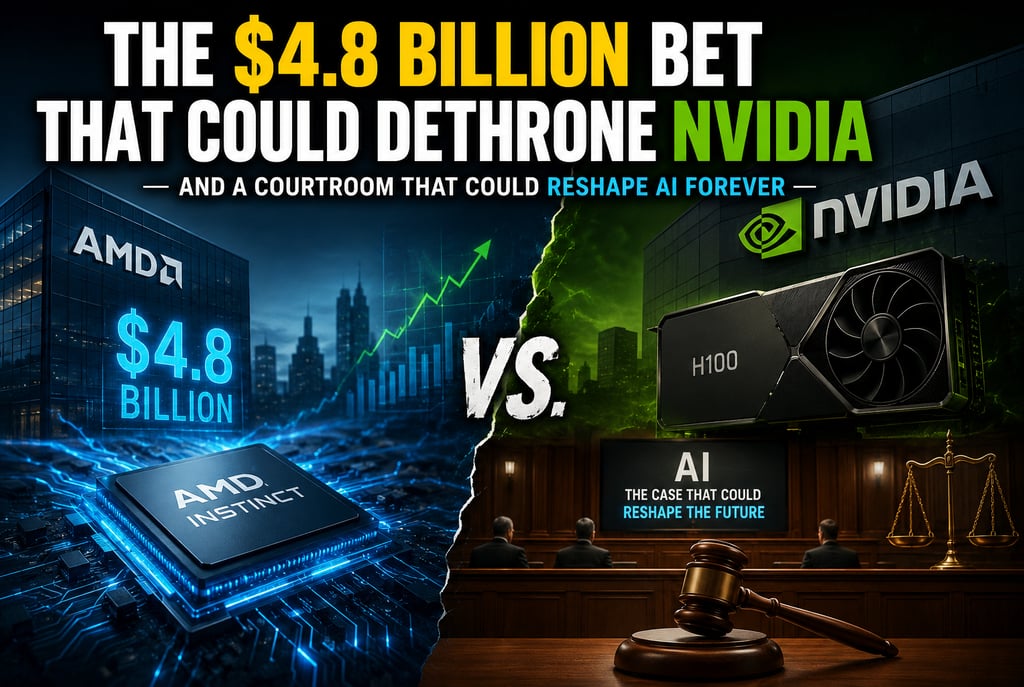
The $4.8 Billion Bet That Could Dethrone Nvidia — And a Courtroom That Could Reshape AI Forever
Two stories dropped this week that will define who controls the AI world for the next decade. One is a chip startup that nobody saw coming. The other is a lawsuit that was always going to happen.
AI AUTOMATION
Jyotsna
5/12/20264 min read
There are weeks in tech that feel like noise. And then there are weeks where you look up and realize — quietly, then all at once — that something fundamental just changed. This is one of those weeks.
Today, two massive stories are competing for the same headline. A Silicon Valley chip startup is about to pull off one of the biggest IPOs in years. And in an Oakland courthouse, the two men who arguably shaped the AI revolution are tearing each other apart in front of a jury. Neither story is a coincidence. Both are symptoms of the same thing: AI has become too big, too valuable, and too powerful for the old rules to hold.
$4.8BCerebras target IPO raise — biggest of 2026
20×oversubscribed before pricing even opened
$852BOpenAI's current valuation at stake in the trial
The chip startup nobody took seriously — until now
Let's start with the money. Cerebras Systems — a company most people outside Silicon Valley have never heard of — just raised its IPO price range by 30%. The offering, now targeting $150–$160 per share, could net the company $4.8 billion when it prices on Thursday. That would make it the largest tech IPO of 2026. And the demand? Orders came in at more than 20 times the shares available. Investors are practically begging to get in.
Here's what makes Cerebras genuinely interesting rather than just another AI hype story: they built something physically different. Instead of making a small chip die like everyone else — including Nvidia — Cerebras turns an entire silicon wafer into one giant chip. The result is a processor that is 58 times larger than a leading GPU, with vastly more memory and no inter-chip latency. For AI inference — the moment your chatbot actually responds to you — Cerebras claims speeds up to 15 times faster than GPU-based alternatives, while using significantly less power.
"It's no longer a niche bet — AI chips have become a core part of how people think about infrastructure."
OpenAI is already a major customer, signing a deal worth over $20 billion in compute capacity over three years. Amazon AWS followed. The US Department of Energy and Department of Defense are on the client list. This is not a startup chasing a dream. It's a company that has quietly become load-bearing infrastructure for the AI economy.
Why this matters to you: If Cerebras succeeds, it proves Nvidia can be beaten on its home turf — and that could drive down the cost of AI for everyone. Cheaper inference means cheaper AI products, faster innovation, and more competition at every level.
Musk vs. Altman: Week three — and it's getting brutal
Meanwhile, in a federal courthouse in Oakland, the trial of the decade entered its third week. Elon Musk is suing OpenAI and Sam Altman, claiming Altman betrayed the company's founding mission — to develop AI safely, for the benefit of all of humanity, not for profit. Microsoft CEO Satya Nadella took the stand on Monday. He told the court he never knew why Sam Altman was fired from OpenAI in November 2023, and wasn't informed in advance. He found out mid-meeting.
The testimony is damning — not necessarily for anyone in particular, but for the idea that the world's most powerful AI company operated with any real governance at all. A UC Berkeley computer scientist called as an expert witness by Musk's team laid out the stakes: "Whichever company develops AGI first would have a very big advantage." Musk himself told the court he believes AI will surpass human intelligence as soon as next year.
OpenAI's counter-argument? That Musk is suing not out of principle, but because the company rejected his offer to merge it with Tesla and put him in charge. The jury gets to decide whose version of history they believe.
"This is not a trial on the safety risks of AI. This is not a trial on whether AI has damaged humanity." — Judge Yvonne Gonzalez Rogers, to the lawyers. Musk ignored her anyway.
The boardroom is changing — whether executives like it or not
A new IBM report released this week found that 76% of large organizations have now appointed a Chief AI Officer — up from just 26% in 2025. That's not incremental. That's a complete restructuring of how corporations make decisions in a single year.
McKinsey's Vivek Lath put it plainly to CNBC: AI is driving what may be the largest organizational shift since the industrial revolution. HR departments are being pushed toward strategy because AI is handling operations. Finance teams are recalibrating because AI is doing the forecasting. And somewhere in the middle, millions of workers are trying to figure out what their job actually looks like now.
The data is actually more optimistic than the headlines suggest. US software developer employment hit a record 2.2 million in 2025 — an 8.5% rise year over year. AI coding tools did not kill developer jobs. They made developers more productive, which made software cheaper, which made companies want to build more software. For now, that's a rising tide.
The bottom line
If you read nothing else today, read this: the AI story is no longer about whether the technology works. It works. The question now is who controls it, who profits from it, and whether the people who built it can be trusted to govern it. Cerebras, Musk, Altman, Nadella — they're all circling the same question from different angles.
The courtroom and the stock market are both, in their own way, trying to answer it. The rest of us are just watching — and deciding what kind of future we want to show up for.