The Artificial intelligence revolution you didn’t notice: Scientists have just made artificial intelligence 100 times more effective.
AI is already consuming more than 10% of all US electricity. A single large AI model training run is a whole hundreds of transatlantic flights of energy.
AI AUTOMATION
Jyotsna
4/24/20264 min read
We talk a lot about what AI can do. We obsess over benchmarks, chatbot wars, and billion-dollar valuations. But there's a question most people aren't asking — one that quietly determines whether the AI boom lasts or burns itself out:
Where is all the electricity coming from?
Right now, AI is consuming over 10% of all electricity used in the United States. A single large AI model training run can use as much energy as hundreds of transatlantic flights. And demand is only accelerating. Data centers the size of small cities are being constructed across the world just to keep up.
It's the dirty secret of the clean-tech future.
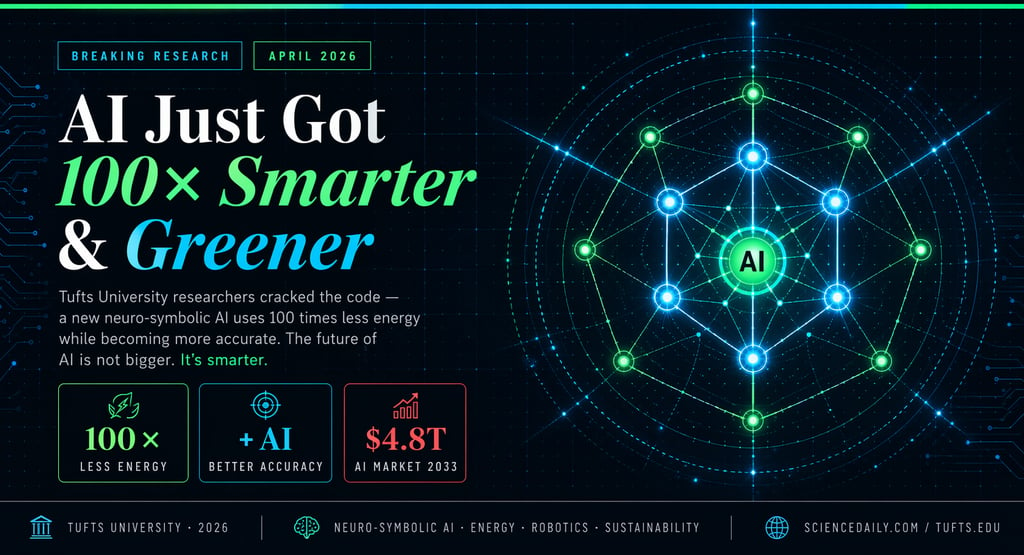
But this week, researchers at Tufts University published something that quietly rewrites the rules — a new AI architecture that cuts energy consumption by up to 100 times, while improving accuracy. This isn't incremental. This is a category shift.
Why AI Is an Energy Monster (And Why That's a Problem)
Before we get to the breakthrough, we need to understand the problem it's solving.
Modern AI — the kind that powers ChatGPT, Gemini, image generators, and everything in between — works through what are called large language models or neural networks. These systems learn by processing enormous amounts of data, over and over, making tiny adjustments billions of times until they get good at a task.
The process is, by design, brute-force. There's no thinking. There's no logic. Just raw pattern-matching, at massive scale, burning electricity every second.
Think of it like hiring a million interns to read every book ever written, hoping that sheer volume eventually produces wisdom. It works. But it costs a fortune — in compute, in energy, and increasingly, in the planet's resources.
"AI operations supported by large server facilities can consume as much energy as a small to mid-size city." — Sandia National Laboratory
And here's the uncomfortable part: as AI gets smarter, it generally gets hungrier. Better models require more data, more computation, more power. The trajectory has seemed inevitable — until now.
Enter Neuro-Symbolic AI: The Hybrid That Changes Everything
The Tufts research team, led by Professor Matthias Scheutz, took a fundamentally different approach. Instead of betting everything on brute-force neural networks, they combined two powerful ideas:
Neural Networks — the pattern-recognition engine that made modern AI possible.
Symbolic Reasoning — the rule-based, logical thinking that humans use to solve structured problems step by step.
The result is what researchers call neuro-symbolic AI. And it works the way your brain actually works.
When you pick up a coffee mug, you don't run a million mental simulations to figure out how much force to use. You reason: it's probably similar to other mugs, it looks about this heavy, I'll grip it here. Logic, categories, structure — not brute-force trial and error.
The Tufts system teaches robots to do the same thing. Instead of burning compute cycles figuring out every possible outcome, it breaks tasks into logical steps and categories — dramatically reducing the work required.
The results were staggering. Same tasks. Same accuracy (actually better accuracy). One hundred times less energy.
What This Actually Means for the Real World
Let's move beyond the lab and talk about why this matters to you — whether you're a developer, a business owner, a policy maker, or just someone who pays an electricity bill.
AI becomes accessible to everyone, everywhere. Right now, running cutting-edge AI requires industrial-scale infrastructure. That's a massive barrier. Most hospitals in India, schools in Africa, or small businesses in Eastern Europe simply cannot afford to build or access this infrastructure. A 100× efficiency improvement doesn't just save energy — it democratizes capability. Suddenly, powerful AI can run on smaller hardware, in remote locations, without a multimillion-dollar cloud bill. That's transformational for global development.
Robotics gets a real-world upgrade. The research was specifically focused on robots performing "long-horizon manipulation tasks" — sequences of actions that require planning and adaptability. Think assembly line robots, surgical assistants, or warehouse automation. With neuro-symbolic AI, these robots become smarter — more capable of reasoning through unexpected situations instead of failing the moment something doesn't match their training data.
The environmental calculus of AI changes. The global AI market is projected to reach $4.8 trillion by 2033. If that growth runs on today's energy-hungry architecture, the environmental cost could be devastating. But if efficiency gains like this become standard, AI's growth no longer has to mean a proportional explosion in carbon emissions. Sustainable AI starts to look genuinely achievable — not just a PR talking point.
It challenges the "bigger is always better" dogma. For years, the dominant philosophy in AI has been scaling — more data, more parameters, more compute equals better AI. This research is a direct challenge to that assumption. Sometimes, smarter design beats raw power. The best AI might not be the largest one — it might be the most elegant one.
The Bigger Picture: A Fork in the Road
We are at a genuine inflection point in AI development.
One path leads toward ever-larger, ever-hungrier models — systems that require nation-state-level infrastructure, concentrate power in the hands of a few massive corporations, and push environmental costs onto the rest of the world.
The other path — the one this research points toward — leads to AI that is leaner, smarter, more logical, and more accessible. AI that doesn't require a data center the size of a city block to deliver real value.
The Tufts team will present this work at the International Conference on Robotics and Automation in Vienna in May 2026. If the research holds up to peer scrutiny — and early indicators are promising — it could mark one of the most important technical pivots of this decade.
The Bottom Line
The AI energy crisis was starting to feel inevitable. A fast car with no brakes, as Nobel laureate Geoffrey Hinton recently put it.
Neuro-symbolic AI doesn't just pump the brakes. It redesigns the engine.
By learning from how humans actually think — with logic, structure, and categories — instead of mimicking them with brute force, researchers have opened a door to a future where AI is not just powerful, but sustainable. Not just accessible to tech giants, but to everyone.
That's not just a scientific achievement. That's a signal.The smartest AI going forward won't necessarily be the biggest. It'll be the one that knows how to think.