The AI gold rush is real — and most of us are still watching from the sidelines
The AI gold rush is feasible, and we are still all spectators. This week in AI was anything but a low-profile week with billion-dollar chip deals and courtroom debacles.
AI AUTOMATION
Jyotsna
4/20/20264 min read
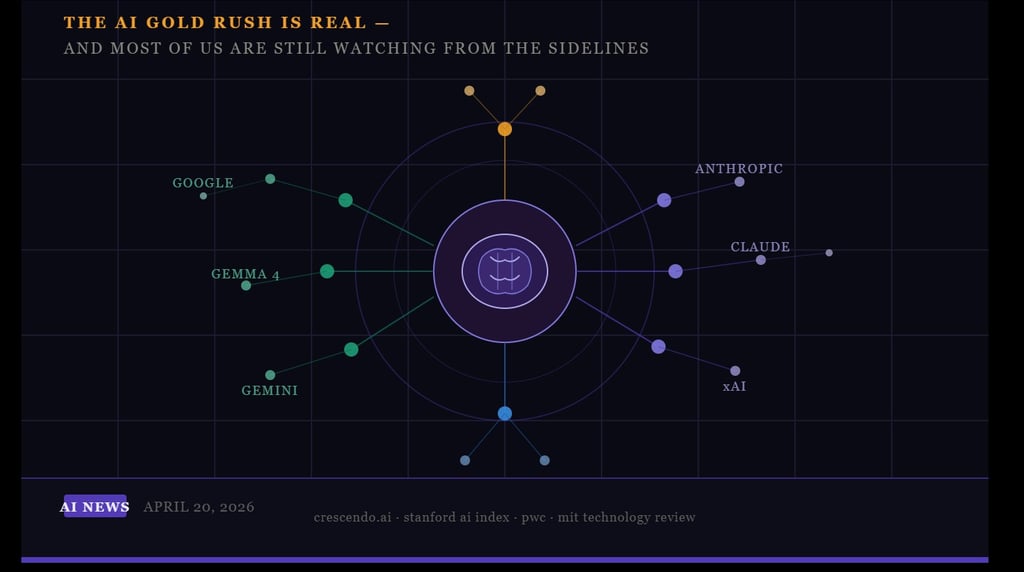
The AI gold rush is feasible, and we are still all spectators.
With the news of AI, it is time to tell the truth: it will be like watering a fire using a firehose in the year 2026 as the number of hoses continues to grow. This week alone: OpenAI secretly began IPO preparations, Google cut a model that could fit on a single GPU and could punch well above its weight, and one lawyer suspended themselves as it allowed an AI to hallucinate 20 cases into the courtroom. Buckle up.
Money & Markets
Officially, OpenAI desires your money.
The rumours are finally solidifying to some reality. OpenAI has already surpassed an annualized revenue of $25 billion, and is currently considering a public listing as early as late 2026. To put it in perspective, Anthropic, its nearest competitor, is approaching $19 billion. A year back that would have been unbelievable. They are almost inevitable now.
And even now, on top of the IPO talk, OpenAI announced itself as having signed a second jaw-dropping agreement in the course of this week to spend above $20 billion over three years on Cerebras chips, possibly securing itself an equity stake in the chip company in the process. Big bet. Huge. Cerebras itself is planning its own public offering in Q2 so this one may become interesting soon.
$20B+
OpenAI commits to spend with Cerebras its chip in 3 years. The AI infra arms race has no indication of deceleration.
There is no witnessed decrease in the gap between AI winners and the rest of the population; instead, the gap is growing wider every day.
On the topic of unequal spoils: a recent PwC research report released this week had its results which most boardrooms would not love to hear. It is only 20% of companies that are capturing 74% of the economic value of AI. The rest? It remains in pilot mode, with continuing lines of proofs-of-concept that never get to production. The leaders are not simply employing more AI, but entirely transforming their business models with them. All the others are refining the same processes as they had in 2023.
Model Wars
Google recently tucked the frontier AI in a lunchbox.
The sequels of the model were issued. Google came up with Gemma 4, or four open-source models, which are capable of running on one 80GB Nvidia H100 GPU and hitting their performance of models 20 times the size. Apache 2.0 licensed, edge-friendly, and obviously geared toward making what LLaMA, at Meta, pretends to be, is expensive and complex. It is the type of launch that overnight shifts the game of startups and individual developers.
Still to be done: Another dropped product of Google is Gemini 3.1 Flash-Lite (priced at a mind-bending $0.25 per million input tokens). It run 2.5 times twice faster than its predecessors. Competition in the big lab cost-efficiency race is now at a stage, in which the intelligence price is technically equal to free.
Grok 4.20 entered the scene on the xAI front, particularly focusing on the factuality issues that plagued earlier incarnations. Tightly pegged to the real-time information stream of X and with a more accurate source tag, it seemingly ranked highest in recent news accuracy among the frontier models that are currently tracking in March, which, in the week we're having in AI, is a handy attribute.
$0.25
Gemini 3.1 Flash-Lite Flash-Lite per Million input token. The cost of AI reasoning is falling - select.
The Bigger Picture
Stanford says we're past the tipping point
The Stanford AI Index declined this week and it is worth stopping and having a look. The main conclusion: the use of AI is speeding up more than the personal computer and the internet did. Not as heavy — heavy. Humans are not shirking of this technology. They're sprinting.
The best performing model as of March 2026 is Anthropic followed by xAI, Google and OpenAI. Models in China have reached competitiveness to such a point that the gap has become razor-thin and the rivalry is transitioning to costs, speed, and real-world reliability, instead of raw benchmark scores.
26%
In software development, AI productivity increase, according to the index of Stanford. The customer service had a 14 percent improvement. Complex judgment tasks? No definite profits.
Reality Check
The secrets no one is speaking about at the key-note.
All this week was not a success. Nebraska lawyer was suspended because of incompetence in his appellate brief, which had 57 ineffective citations, including 20 overall AI forgeries. Fake cases. Fake quotes. Nonexistent statutes. He denied using AI. The court didn't believe him. He is not the only one: U.S. courts are currently imposing at least 145,000 in sanctions on lawyers for AI citation mistakes in the first quarter of 2026 alone.
And in the UK, a study also determined that currently, 59 per cent of the population has been using AI to self-report medical symptoms, an act that is mostly due to the fact that it takes weeks to see a GP. It is a very human narrative couched on top of a technology trend: it is not that people are flocking to AI because it is flawless, but that it is only that other options have failed them.
Elsewhere, McKinsey sparked the discussion by adding an AI interview round to its graduate recruitment process, during which candidates go through its in-house AI solution Lilli to resolve business challenges on exam. The company has already deployed an artificial intelligence army of 20,000 and 40,000 humans. The message is understood, when you cannot work with AI you will not be offered the employment.
People are not looking to AI because it is flawless - they are looking to AI because the other option has failed them.