The AI Gold Rush Is Here — And It's Changing Everything You Know About Business, Jobs, and the Future
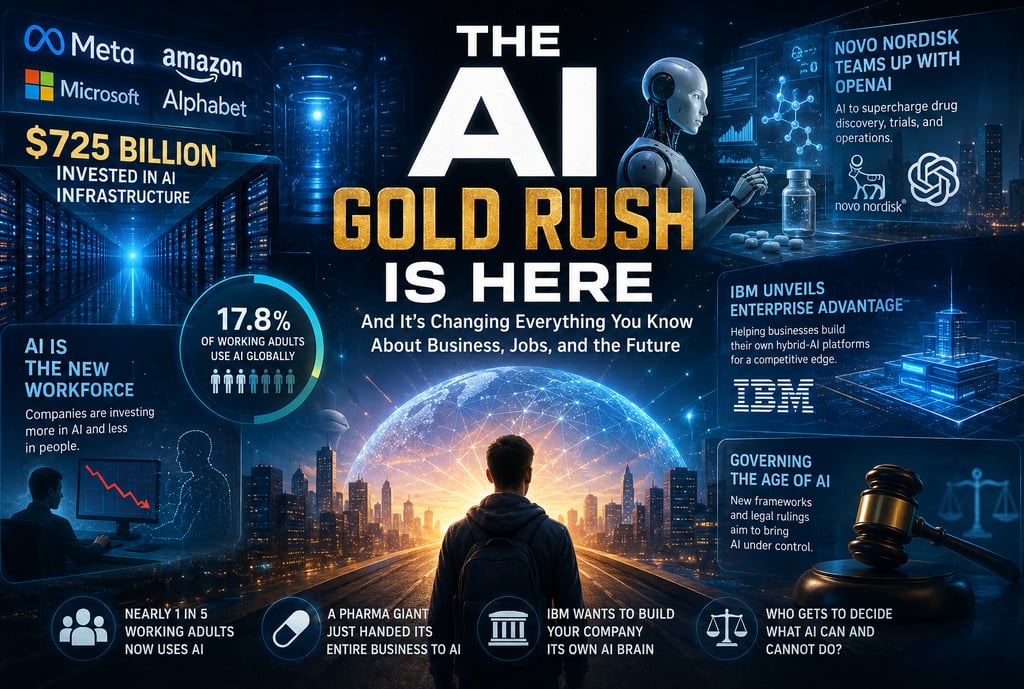
Meta, Amazon, Microsoft, and Alphabet have collectively committed a jaw-dropping $725 billion in spending for 2026 — and almost every penny is going toward AI infrastructure. We're talking about data centers, custom chips, and next-generation AI models. Compared to last year, that's a 75% increase in spending. In one year.
AI AUTOMATION
Jyotsna
5/9/20264 min read
If you thought the AI wave was just a tech buzzword, think again. What's happening right now in the world of artificial intelligence isn't just a trend — it's a full-blown economic and cultural revolution. And whether you're a business owner, a student, or someone just trying to keep up with the times, this affects you.
Let's break down the biggest AI developments of this week — in plain English, no jargon, no fluff.
Big Tech Just Bet $725 Billion on AI. Here's What That Means for the Rest of Us.
Yes, you read that right. Seven hundred and twenty-five billion dollars.
Meta, Amazon, Microsoft, and Alphabet have collectively committed a jaw-dropping $725 billion in spending for 2026 — and almost every penny is going toward AI infrastructure. We're talking about data centers, custom chips, and next-generation AI models. Compared to last year, that's a 75% increase in spending. In one year.
To put that in perspective: that's more than the entire GDP of many countries, being poured into a single technology.
But here's the twist that most headlines are missing: while companies are spending more on AI, they're spending less on people. Meta is cutting 8,000 jobs this month. Amazon has already let go of around 30,000 employees in recent months. Microsoft offered voluntary buyouts to 125,000 of its own staff.
This isn't a coincidence. It's a strategy. These giants are deliberately replacing human labor costs with computing power. The message is clear — the future of work is being rewritten, and it's being rewritten fast.
Nearly 1 in 5 Working Adults Now Uses AI. Are You One of Them?
Microsoft just dropped its Global AI Diffusion Report, and the numbers are eye-opening.
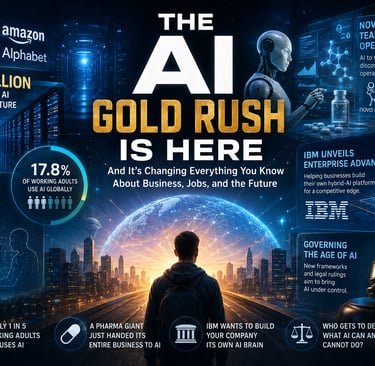
As of early 2026, 17.8% of the world's working-age population actively uses AI — up from 16.3% just a few months ago. That means nearly one in five working adults on the planet is now using AI as part of their daily or professional life.
Some countries are leading the charge. The UAE tops the global list at a staggering 70.1% adoption rate. That means almost 3 out of every 4 working adults there are using AI regularly. The United States, often considered the birthplace of modern tech, has climbed to 21st place globally with a 31.3% usage rate.
The takeaway? AI isn't a niche tool for tech nerds anymore. It's becoming as common as email. And those who haven't started learning it yet might find themselves playing catch-up sooner than they think.
A Pharma Giant Just Handed Its Entire Business to AI
In a move that signals just how seriously industries beyond tech are taking AI, Novo Nordisk — the Danish company behind the Ozempic weight-loss drug — announced a sweeping partnership with OpenAI.
The deal covers everything: drug discovery, clinical trials, manufacturing, supply chains, and even commercial operations. The goal? To speed up the development of new treatments for obesity and diabetes while staying competitive against rivals like Eli Lilly.
Novo Nordisk's CEO put it simply: the aim is to "supercharge" scientists, not replace them. But in the same breath, the company admitted AI would slow down future hiring.
This is a glimpse of what's coming in virtually every industry — from healthcare to finance to education. AI won't just be a tool sitting in IT. It will be woven into the DNA of how companies operate.
IBM Wants to Build Your Company Its Own AI Brain
At its annual Think 2026 conference this week, IBM unveiled something it's calling Enterprise Advantage — a consulting service designed to help businesses build and run their very own hybrid-AI platforms.
Translation: IBM wants to be the company that hands every major enterprise a custom-built AI engine, tailored to their specific workflows and data. Partners like Amazon Web Services, Pearson, and Providence joined IBM on stage to demonstrate real-world deployments.
This is significant because it signals the next phase of AI adoption. We're moving past the era of simply using AI tools — and into an era where companies are building their own AI systems from the ground up. The businesses that do this well will have a serious competitive edge over those that don't.
Who Gets to Decide What AI Can and Cannot Do?
With AI growing this fast, governments and institutions are scrambling to set boundaries.
This week, Yale University's Chief Executive Leadership Institute published a landmark governance framework for so-called "agentic AI" — AI systems that can take actions on their own, make decisions, and operate with minimal human oversight. The framework was sparked in part by concerns around increasingly autonomous AI models.
Meanwhile, a U.S. federal court in California made a ruling that could shake up the entire digital advertising industry: if an AI system has "ultimate authority" over how ad content is assembled, the platform behind it could be held legally liable for fraud under securities law.
These are early but important signs that the world is starting to get serious about AI accountability. The wild west era of AI doing whatever it wants, unchecked, is beginning to close.
So, What Does This All Mean for You?
Here's the honest truth: AI is no longer something you can afford to ignore.
If you run a business, your competitors are already looking at how to integrate AI into their operations. If you're an employee, understanding how AI works — and how to work alongside it — is quickly becoming as important as knowing how to use a computer.
And if you're simply curious about where the world is heading, you're watching it unfold in real time.
The companies investing billions today are betting that AI will define the next decade of human productivity, creativity, and commerce. Based on the speed of what we're seeing, it's hard to argue with that bet.
The question isn't if AI will change your world. It already is.
The question is: will you be ready?
Stay ahead of the curve. Bookmark this blog for weekly AI updates written in plain language — because understanding the future shouldn't require a PhD.