
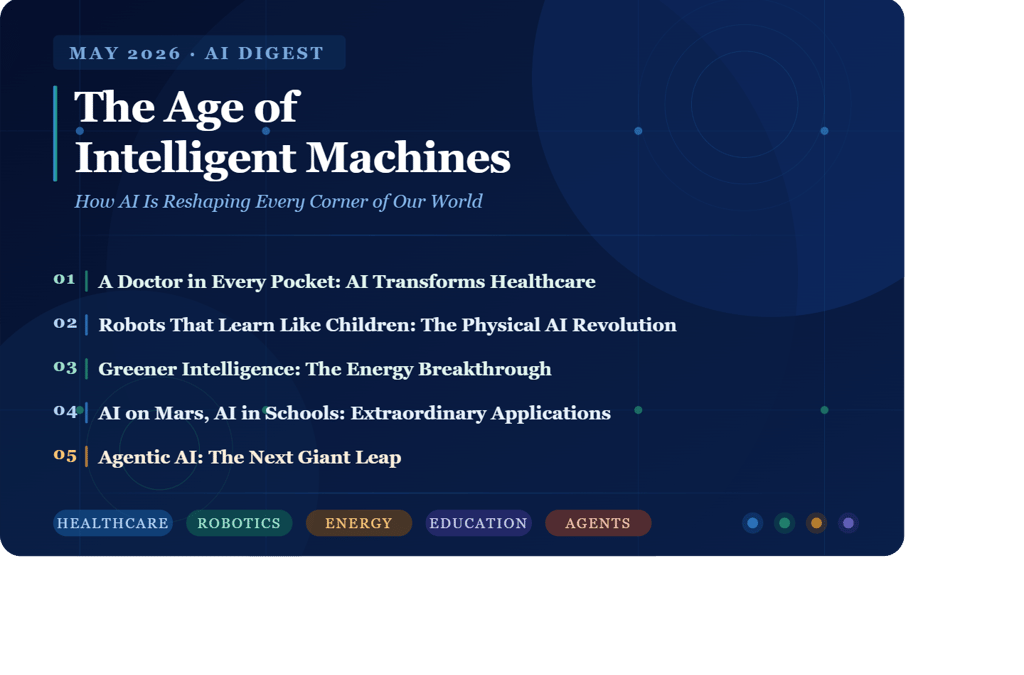
The Age of Intelligent Machines: How AI Is Quietly Reshaping Every Corner of Our World
From healing hospitals to guiding rovers on Mars, artificial intelligence has stepped out of science fiction and into the fabric of daily human life — and the pace of change is only accelerating.
AI AUTOMATION
Jyotsna
5/2/20265 min read
We are living through one of the most consequential technological shifts in human history. Artificial intelligence — once the exclusive domain of researchers and science-fiction writers — is now embedded in healthcare systems, school curricula, farming fields, climate models, and even the surface of Mars. The breakthroughs arriving in 2026 are not incremental upgrades; they represent genuine leaps in what machines can understand, create, and accomplish alongside us.
This is not a story about robots taking over. It is a story about possibility — about what happens when humanity's most powerful cognitive tool becomes available to doctors, teachers, scientists, and farmers around the world. Here is what is happening right now, and why it matters.
A Doctor in Every Pocket: AI Transforms Healthcare
Perhaps nowhere is AI's benefit more visceral than in medicine. Researchers at the University of Michigan have developed an AI system capable of interpreting brain MRI scans in seconds — accurately identifying a wide range of neurological conditions and flagging the most urgent cases for immediate attention. In emergency medicine, where minutes separate recovery from permanent damage, this is revolutionary.
Breaking in Healthcare AI
AI Reads Brain Scans in Seconds — Transforming Emergency Neurology
Trained on hundreds of thousands of MRI scans, the University of Michigan's new AI system can analyze neurological imaging almost instantly and triage patients by urgency — a capability that could dramatically improve survival rates and reduce permanent brain damage in stroke and trauma cases.
The transformation goes deeper than diagnostics. Generative AI is now being used to automate clinical documentation, convert patient-clinician conversations into structured medical notes, and surface potential care gaps before they become crises. According to healthcare technology experts at Wolters Kluwer, these tools are already reducing administrative burden significantly for early-adopter health systems, freeing doctors to spend more time with patients and less time on paperwork.
"Generative AI is revolutionizing healthcare — offering transformative capabilities in clinical documentation, decision support, patient communication, and medical education."
— Wolters Kluwer Health, 2026 Healthcare AI Trends Report
Google's annual health event, The Check Up 2026, committed $10 million to reimagine clinician education in the AI era. Fitbit's AI-powered personal health coach now integrates medical records directly into personalized sleep and wellness advice. The goal is no longer just treating disease — it is continuous, intelligent, preventive care for everyone.
🤖 Robots That Learn Like Children: The Physical AI Revolution
The next frontier in AI is physical — machines that can see, understand, and act in the messy, unpredictable real world. NVIDIA's GTC 2026 conference showcased a generational leap in what are called "physical AI" systems: robots that learn from simulated environments and carry that knowledge seamlessly into real-world tasks.
Robotics Breakthrough
NVIDIA's New Robot Models Understand Natural Language — No Coding Required
New Isaac GR00T open models allow robots to understand plain-language instructions and execute complex, multi-step physical tasks. A developer can now tell a robot "move two meters forward and pick up the object" in plain English — and it does. The sim-to-real gap that has historically limited robot deployment is rapidly closing.
Agricultural AI is also blossoming. AI-powered rovers from Aigen are helping farmers practice regenerative agriculture — identifying and removing weeds without chemicals, while healing soil and restoring ecological balance. This is AI in service of the land, not just the laboratory.
Meanwhile, NVIDIA and Cadence Design Systems announced a joint platform combining world-class physics simulation with AI agent orchestration — a system designed to train and test robots across millions of virtual scenarios before they ever touch the real world, making deployment faster, safer, and far more reliable.
Greener Intelligence: The Energy Breakthrough Nobody Is Talking About
There is an uncomfortable truth at the heart of the AI boom: it consumes enormous amounts of electricity. According to the International Energy Agency, AI systems and data centers already account for more than 10% of total US electricity production — a figure projected to double by 2030.
Sustainability Breakthrough
Tufts Researchers Cut AI Energy Use by 100x — While Improving Performance
Researchers at Tufts University's School of Engineering have developed a neuro-symbolic AI system that combines traditional neural networks with human-like symbolic reasoning. The result: up to 100 times lower energy consumption on robotic tasks, with better accuracy than conventional approaches. This mirrors how humans solve problems — breaking them into steps and categories — rather than brute-force pattern matching.
This breakthrough points toward a future where powerful AI does not necessarily mean a massive carbon footprint. Combined with light-powered chips from the University of Florida — which use photons instead of electrons — the path to sustainable, high-performance AI computing is becoming clearer by the month.
AI on Mars, AI in Schools: Extraordinary Applications
NASA's Perseverance rover recently completed the first Mars drives ever planned by artificial intelligence. Using Anthropic's Claude vision-language models, the rover analyzed orbital imagery and terrain data to autonomously generate safe waypoints — executing exploration tasks that would have taken human mission controllers days to plan, in near real-time.
Back on Earth, UNICEF has identified AI as a pivotal tool for children in developing economies — accelerating access to quality education, healthcare, and climate resilience in communities that have historically been underserved by technology. The organization is actively working to ensure AI is designed with children's rights at its core, not as an afterthought.
Education & Equity
AI Is Making Quality Education a Global Reality, Not a Privilege
From personalized learning systems that adapt to each student's pace, to AI tutors that speak local languages, to tools that help teachers identify struggling students before they fall behind — artificial intelligence is becoming one of the most powerful forces for educational equity the world has ever seen. UNICEF is partnering with governments and innovators to scale these tools across low-resource communities globally.
🌐 Agentic AI: The Next Giant Leap
MIT Technology Review's 2026 analysis identifies the rise of agentic AI — systems that do not just answer questions, but take sequences of actions, use tools, browse the web, write code, and complete complex goals with minimal human supervision — as the defining trend of this year. The first wave of AI agents acted alone. What comes next are teams of agents that cooperate, divide tasks, and achieve goals that no single model could tackle independently.
This shift is already reshaping entire industries. Automotive dealerships are deploying integrated AI systems that handle everything from inventory prediction to personalized sales outreach. Legal firms are using AI to analyze contracts in minutes rather than weeks. Financial institutions are using AI to detect fraud patterns invisible to human analysts.
The Bottom Line: AI as a Force for Human Flourishing
The narrative around artificial intelligence is often dominated by fear — job losses, deepfakes, surveillance, and existential risk. These are real concerns that deserve serious attention. But the story of AI in 2026 is also, and perhaps primarily, a story of extraordinary human benefit. Cancers caught earlier. Students reached in remote villages. Rovers exploring alien worlds autonomously. Farmers healing their land with robotic precision. Scientists solving energy equations that were once impossibly complex. The technology is not perfect, and its governance must keep pace with its power. But in the hands of thoughtful people working toward good ends, artificial intelligence may be the most powerful tool for human flourishing ever created.