AI is Stealing $172 Billion of Value Silently - And Few Have Even Noticed.
Assess when was the last time a technology has truly transformed your approach to work, learning, or problem-solving. The smartphone, perhaps the internet, was that in the case of most of us.
AI AUTOMATION
Jyotsna
4/22/20264 min read
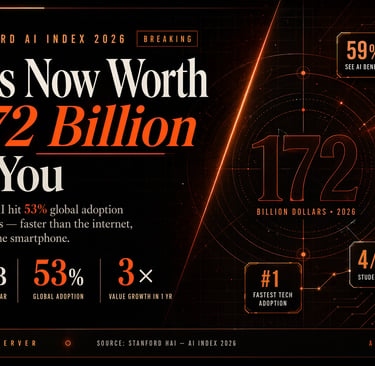
Consider when a technology in actuality transformed how you work, learn, or solve problems. That was the smartphone to most of us, perhaps the internet prior to that. However, we are living through something bigger according to one of the most credible research institutes all over the world. And, unspoken, without the attention of many, artificial intelligence has already begun to pay us back.
The Numbers That Should Make You Stop in Your Tracks.
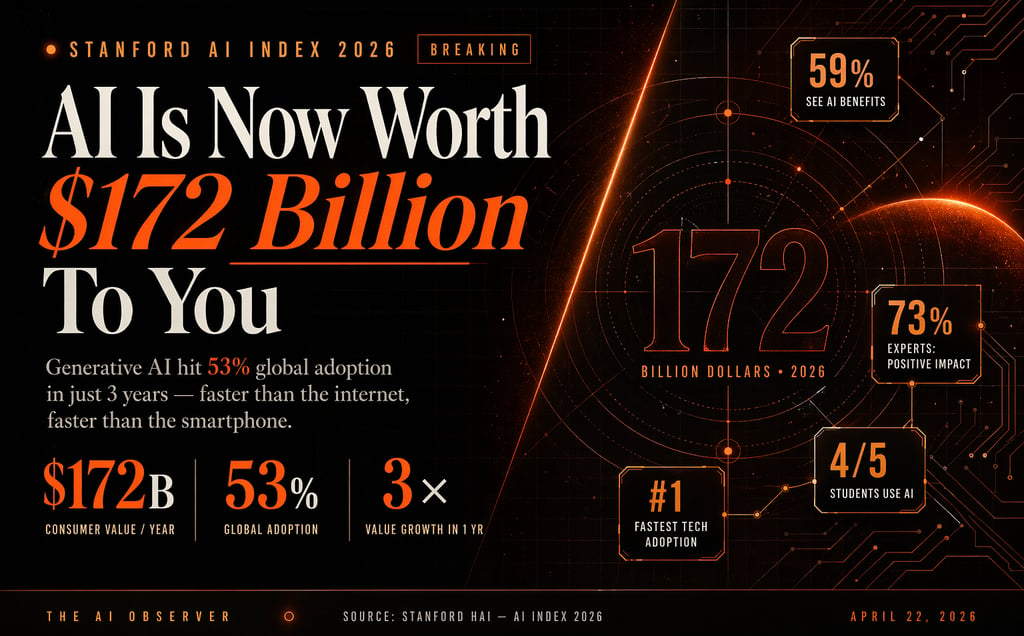
This month, the Institute of Human-Centered Artificial Intelligence at Stanford University published its 2026 AI Index and the results are no less than historic. According to the report, generative AI applications are currently providing U.S. consumers alone with $172 billion worth of yearly value. In perspective that is more than the total GDP of such countries as Hungary or Kuwait.
But what makes it even more impressive, a lot of this value is being provided at no cost, or at a few dollars monthly by subscription that is cheaper than a dinner out. Individuals are receiving research assistance and creative support, codeset support, medical information, language translation as well as career advice, something that would have been thousands of dollars in professional fees only a few years back.
Key Data Indicator: Within 2025-2026, the median value per AI user nearly tripled. It only takes 12 months to triple what people are getting out of these tools- three times more- without having to pay three times more.
Going Viral Faster Than the Internet Ever Did.
We have the tendency to idealize the early years of the internet as an overnight revolution that swept the globe. The fact is that, the adoption of the internet has exceeded more than 20 years before it could reach half of the world. The PC was even slower.
It took Generative AI three years to do it.
Stanford report states that now, generative AI is on 53% population adoption rates, which is even higher than the positions of the PC and the internet in their history. And that is not a mere statistic. It is a remark on how badly people were in need of what AI can provide them with: quick, smart, 24/7 service.
Singapore (61%), UAE (54%), and other countries lead the rate of adoption in the world, which informs us about something interesting: in case of strong digital infrastructure, and population highly concerned with technology, AI is becoming our close companion almost instantly. Surprisingly, the US is much lower with 24 th place 28.3- this indicates that there is still a gigantic space to expand even in the most developed tech market in the world.
What Is It actually putting in to People?
This can be an impressive number of 172 billion and it can get abstract. So we had better base it on the facts. So what exactly does AI do to people on a daily basis to justify it to a tune of that amount?
Students and Learners
In the U.S. four out of five high school and college students are now using AI in school work. It can be learning a challenging subject, receiving comments about a rough thesis, or breaking down a math problem bit by bit, but AI is now the study companion that will never grow weary, never critique, and will not charge ten dollars per hour.
Workers and Professionals
The specialists are much more enthusiastic about the impact of AI on the workplace than the general population- 73% of experts think that AI will positively impact the way people work. Programmers, writers, lawyers, and analysts, and more, are all saying that they have AI tackling the tedious, time-intensive aspects of their workloads, letting them continue with the portions of their tasks that do not need an automated system and reportedly a real person to tackle.
Everyday Problem-Solvers
Democratization of expertise is, perhaps, the least obvious benefit. A person in the small town in India can now receive equal quality of legal, medical or financial advice as a person in Manhattan, not not only through a licensed practitioner, but an AI accessing millions of sources and explaining the information in plain language. Such a mute-levelling effect is worth a lot more than any headline figure.
The Change in the Social Consciousness.
The report by Stanford is one of the most indicative ones, since people began to change their attitude towards AI. Fear was the order of the day a little more than a year ago: job losses, deepfakes, misinformation, existential risk. And though those concerns have not gone, it is the subject of a quiet change in the narrative that the population is undergoing.
Currently, half of the world believes AI will bring more good than harm, with a rise in the numbers to 59 per cent compared to last year. The seven-point year-to-year change is remarkable. It implies that as individuals come to use these tools in practice that the abstract fear gives way, in turn, to a metal more: cautious, evidence-based optimism.
Yes, 52% of them also feel nervous by AI. They can be true of these two. You are able to trust that something is really strong, that there are risks involved, and you know and trust that it works and think that it is really good and applicable in your life. It is a grown-up, sophisticated affair with techno-stuff--and it is good.
The Implications of this in the future.
The dollar amount of 172 billion is not a limit- this is a floor. We are just in the initial phases of appreciating what these tools are capable of doing. Modelling is also getting better. Adoption is climbing. Most importantly, the manner in which individuals apply AI is maturing: the value per user increases threefold in a single year is an indication that the more individuals enhance their way of operating with AI, the more they can desire it to accomplish.
The problem with AI and the drama of billion-dollar funding rounds and frontier design models fighting over the benchmark is not the real story of AI in 2026. It is a lot closer and privately, a lot deeper than that. And it is the student in the country village who, after all, has access to a patient and a tutor with knowledge. The small business owner is the one who is able to write professional content without contracting an agency to do the same. The parent who is able to obtain straight answers to questions about their health at 2 in the morning is the old one.
And that is the amount of the $172 billion in reality. Not spreadsheet - but in lives, interaction at a time, helpful.
Bottom Line
The Stanford 2026 AI Index renders one fact indisputable: artificial intelligence has turned into a promise of the future. It is an existing advantage already trickling down to hundreds of millions of people throughout the world - faster, and of better value, than any previously existing technology.