AI Is Not Coming for Your Job — But It Is Quietly Rewriting Everything Else
From Apple handing you the keys to your own AI model, to global adoption numbers that will make your jaw drop — this week in artificial intelligence changed more than you think.
AI AUTOMATION
Jyotsna
5/11/20263 min read
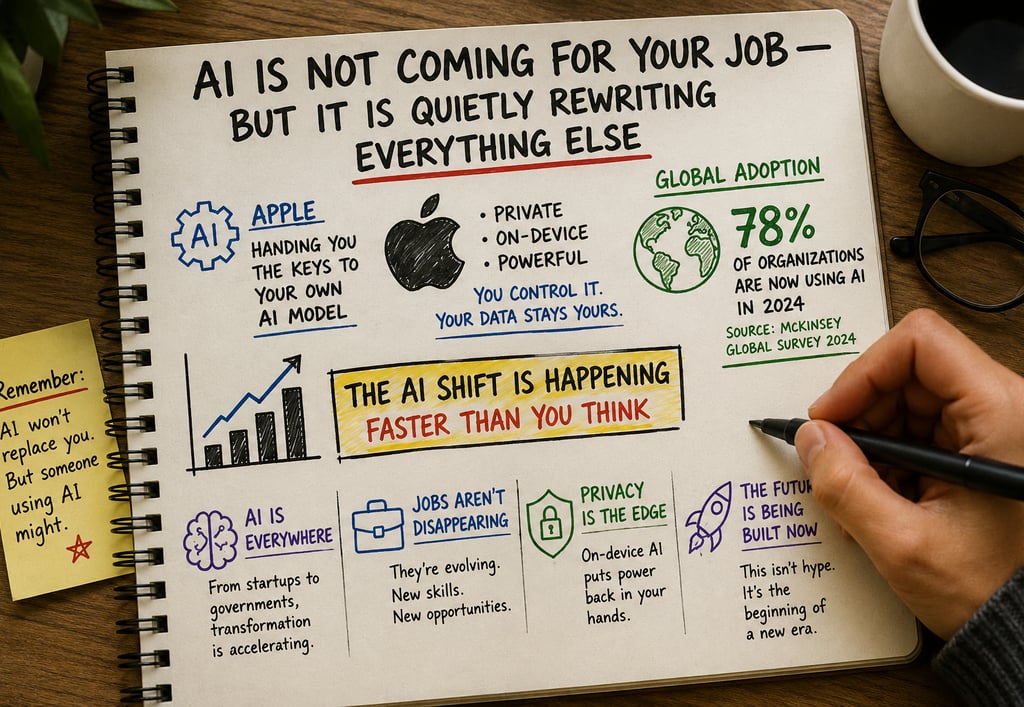
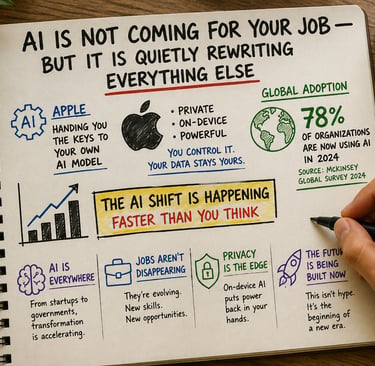
Let's be honest — every week feels like a new chapter in a science fiction novel these days. But this week's AI news isn't just noise. It's a signal. And if you've been quietly wondering whether the robots are really coming for your desk job, your iPhone, or your company's boardroom... keep reading.
The headlines are louder than ever, but the truth underneath them is actually more interesting — and a little more reassuring — than most people realize.
17.8%of working-age people globally now use AI
70.1%UAE leads global AI adoption rate
78%rise in global developer git pushes year-over-year
The big one
"Your job is safe — but your job description? That's another story."
Here's the part everyone's been anxious about. A CNN report published yesterday confirmed what many researchers have suspected for months: AI is not wholesale replacing people. Not yet, anyway. What it IS doing is hollowing out specific tasks — the repetitive, mechanical, "do this the same way every time" kind of work.
Companies are keeping their people but restructuring what those people actually do. A software engineer at a fintech firm told CNN that her daily work now involves a mix of writing code and prompting AI — a hybrid role that didn't have a name three years ago. Boris Cherny, head of Claude Code at Anthropic, put it bluntly: by end of 2026, the title "software engineer" might give way to something like "builder" — a person who shapes systems rather than just writes lines of code.
"The anxiety around AI at work is real — but companies are using it to reshape jobs, not erase people. The question isn't 'will I be replaced?' It's 'what will my job look like in 18 months?'"
Big tech move
Apple just flipped the script on AI — and it's bigger than most people noticed
Buried under the job headlines was something quietly massive: Apple is reportedly planning to let you choose your own AI model on iOS 27. Not just Siri. Not just Apple Intelligence. You could pick Google's Gemini, or Anthropic's Claude, to power how your phone thinks.
This is Apple admitting it doesn't have to win the AI race alone — and opening the door for a genuine AI marketplace on your phone. The feature, reportedly called "Extensions," would let third-party AI providers integrate through the App Store. That's not a tweak. That's a platform shift.
Around the world
The world is using AI more — and some countries are moving faster than you'd expect
Microsoft's latest Global AI Diffusion Report dropped this week, and it's full of surprises. Global AI usage has climbed from 16.3% to 17.8% of the working-age population in just one quarter. That sounds small — until you realize that's millions of new users in a matter of weeks.
The UAE sits at 70.1% — meaning nearly 7 in 10 working-age Emiratis are actively using AI. The US, despite being home to most of the world's biggest AI companies, only ranked 21st globally at 31.3%. India and Southeast Asia are accelerating fast, driven by AI that's getting better at local languages — Hinglish, Thai, Korean. This isn't a Silicon Valley story anymore. It's a global one.
The breakup nobody saw coming
Snap and Perplexity ended their $400M AI deal — here's why it matters more than the money
It was supposed to be one of the bigger AI integrations of early 2026: Perplexity's AI search baked directly into Snapchat for 400 million dollars. It never happened. Both sides say it ended "amicably," but let's read between the lines — integrating AI chatbots into social platforms is harder than it looks, and the user trust and safety questions are genuinely thorny.
This isn't failure — it's the industry learning what actually works. Not every AI partnership makes sense just because the technology is impressive.
Final thought
Here's what all of this is really telling us
AI in 2026 isn't the terminator. It's not a utopia either. It's something messier and more interesting — a technology that is deeply embedded in daily life now, reshaping industries from the inside, creating new roles while quietly retiring old ones, and still figuring out where its limits are.
The smartest thing you can do right now? Stay curious. Not anxious — curious. The people who are thriving in this moment are the ones asking "how does this change what I do?" rather than "will this replace me?"
Because the answer to the first question? That's entirely up to you.