AI in 2026: Why This Is the Most Important Technology You'll Ever Use in Your Lifetime
When I first heard the word "artificial intelligence," I pictured robots. Sci-fi movies. Something cold and distant, decades away.
AI AUTOMATION
Jyotsna
4/27/20265 min read
Let me be honest with you for a second.
When I first heard the word "artificial intelligence," I pictured robots. Sci-fi movies. Something cold and distant, decades away.
I was wrong.
AI isn't coming in the future. It's already sitting inside your phone, your hospital, your child's classroom — and most people haven't even noticed yet. That's not a warning. That's actually the most exciting thing I've written all year.
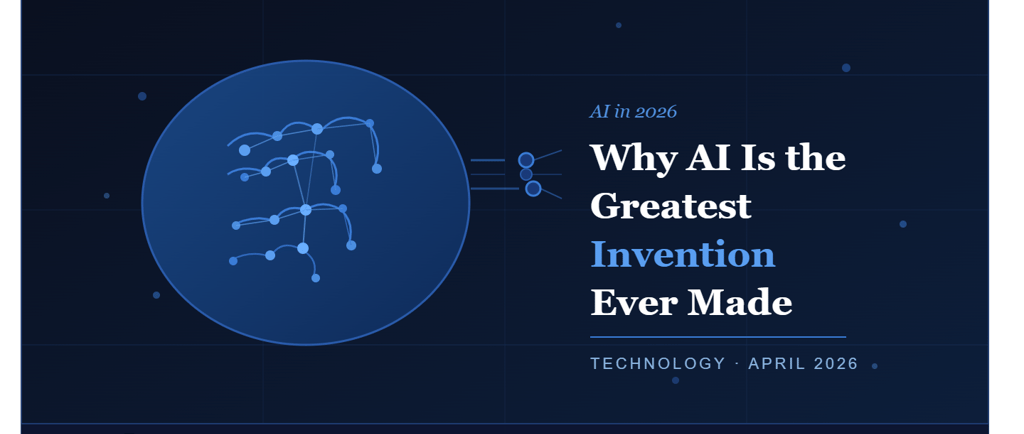
Here's why AI is the single most important invention of our time, why you need to understand it right now, and what's actually happening with it in 2026 — no hype, no fluff.
What Is AI, Really? (Skip This If You Already Know — But You Might Be Surprised)
Most definitions of AI are either too simple or too technical.
Here's mine: AI is a system that learns from information and uses what it learns to make decisions, create things, or solve problems — without being told exactly how to do it every single step of the way.That last part matters. A calculator follows instructions. AI figures out its own instructions. That's the difference between a tool and a thinking partner.
And in 2026? It's a very good thinking partner.
The Moment AI Stopped Being Theoretical
There's a specific moment I think about when people ask me why AI matters.
In 2021, Google DeepMind's AlphaFold solved what scientists called the "protein folding problem" — a puzzle that had stumped biology for over 50 years. Proteins are the building blocks of every living thing. Understanding how they fold into 3D shapes is the key to understanding disease, designing drugs, and curing illnesses that have killed millions.
For half a century, the world's best scientists couldn't crack it fully.
AlphaFold did it — and made the results free for every researcher on earth.
That single moment unlocked new research into Alzheimer's, cancer, malaria, and rare genetic diseases that previously had no treatment pathway. Not in theory. Right now. Labs worldwide are using it today.That's when AI stopped being about chatbots and started being about survival.
Why 2026 Is Different From Every Year Before It
Every year since 2020, someone has said "this is the year AI changes everything." And every year, the skeptics had a point — it was impressive but limited.
Not anymore.
Stanford's 2026 AI Index confirmed what many of us already felt: generative AI reached 53% global adoption in just three years. For reference, the internet took over a decade to hit similar numbers. The personal computer took longer. AI is moving at a speed we've genuinely never seen.
And the value? The estimated benefit to U.S. consumers alone hit $172 billion in early 2026. The median value per user — meaning what the average person gets from using these tools — tripled in a single year.
Tripled. In twelve months.
The 3 Real Reasons AI Is Exactly What the World Needs Right Now
I'm not going to give you a list of ten things. Nobody remembers ten things. Here are the three that actually matter.
First: The world's problems are too big for humans working alone.
Climate change. Cancer. Drug-resistant bacteria. Food security for 10 billion people. These aren't problems you can brute-force with more committees and longer meetings. They require pattern recognition across billions of data points, running thousands of experiments simultaneously, and making connections across fields that no single human brain can hold at once. AI can do all of that. We need it to.
Second: Expertise has always been unfairly distributed.
If you grew up in a city with good schools and wealthy parents, you had access to great tutors, great doctors, great legal advice. If you didn't — you didn't. AI is the first technology that genuinely democratises expertise. A student in a small village in Punjab can now access the same quality of educational support as a student in London. That's not a small thing. That's one of the most profound equity shifts in history.
Third: We're running out of time on problems that have deadlines.
Climate models, pandemic preparedness, antibiotic resistance — these aren't patient problems. They don't wait for the next generation of scientists to train. AI compresses decades of research into years. That compression isn't convenient. In some cases, it's the difference between solving the problem and not.
What's Actually Happening in AI Right Now — April 2026
Here's your honest, no-nonsense update on where things stand today.
DeepSeek just launched V4 Pro. China's most ambitious AI lab dropped a new flagship model this week, claiming best-in-class performance on coding benchmarks and a new memory architecture for long conversations. The US-China AI race is closer than it's ever been — separated by fractions of percentage points on most benchmarks.
Meta is spending $115 to $135 billion on AI this year. That's nearly double what they spent last year. They've also launched their first proprietary large language model, Muse Spark — abandoning their open-source-only strategy. When Meta bets that kind of money, pay attention.
AI is now outperforming professionals in their own fields. GPT-5.4 scored 83% on a benchmark testing real-world performance across 44 occupations — including nurses, financial analysts, lawyers, and engineers. That's not AI being impressive in a lab. That's AI being useful in the real world.
The Question Everyone Keeps Avoiding
Will AI take jobs?
Honestly? Some. Yes. It already has in certain areas.
But here's what the data actually shows in 2026: AI is changing tasks inside jobs far more than it's eliminating the jobs themselves. New roles are being created — AI trainers, model evaluators, prompt specialists, ethics reviewers. And workers who learn to use AI effectively are becoming dramatically more valuable, not less.
The analogy I keep coming back to is the spreadsheet. When Excel arrived, accountants didn't disappear. The bad ones did. The good ones became indispensable because they could now do in an hour what used to take a week.
Same thing is happening now. Just faster. And bigger.
What You Should Actually Do With This Information
Read about it. Seriously. Not just articles like this — the actual products. Use an AI tool this week if you haven't. Try it for something real in your life or work.
Because here's the uncomfortable truth: understanding AI is becoming basic literacy. Not for tech people. For everyone. The Stanford report found that 4 in 5 U.S. students now use AI for school. The generation entering the workforce in the next few years has grown up with this.
If you're not at least curious, you're not just behind the curve — you're behind the generation coming up behind you.
Final Thought
The printing press didn't just change how books were made. It changed who got to think out loud — and who had to listen. Power shifted. Knowledge spread. The world reorganised itself around a new technology.
AI is doing the same thing. Right now. In 2026.
The only question is which side of that reorganisation you want to be on.